
UltraBall Research · Vintage vs modern divergence
Vintage Pokémon Index Rises 4.3% as Modern Falls 9.1%, Opening a 13.4-Point Gap
UltraBall's indexes split over 30 days: vintage up, modern down, yet modern sales per day rose faster in tracked eBay US sales.
By UltraBall Research · Published 31 October 2026 · 23 September to 22 October 2026
Key findings
- 1UltraBall's Vintage index rose +4.3% over the 30 days to 22 October 2026 while the Modern index fell −9.1%, a gap of 13.4 percentage points.
- 2Modern sales per collected day rose +28.0% on the previous 30 days, to 9,531, even as modern prices in the index fell.
- 3Vintage (WOTC era) sales per collected day rose +7.7% to 2,681, moving in the same direction as vintage prices.
- 4Since 1 August, the Vintage index is up +6.6% and the Modern index is down −13.8%.
- 5The Vintage index stands at 106.6 and the Modern index at 86.2, as calculated on the day of writing.
Over the 30 days to 22 October 2026, UltraBall's Vintage index rose 4.3% while its Modern index fell 9.1%.
- Source:
- UltraBall Pokémon Card Market Research
- Dataset:
- UltraBall Vintage and Modern indexes
- Period:
- 23 September to 22 October 2026
Vintage against Modern over 30 days
+13.4 ptsVintage minus Modern, 30-day change
- Vintage+4.3%
- Modern-9.1%
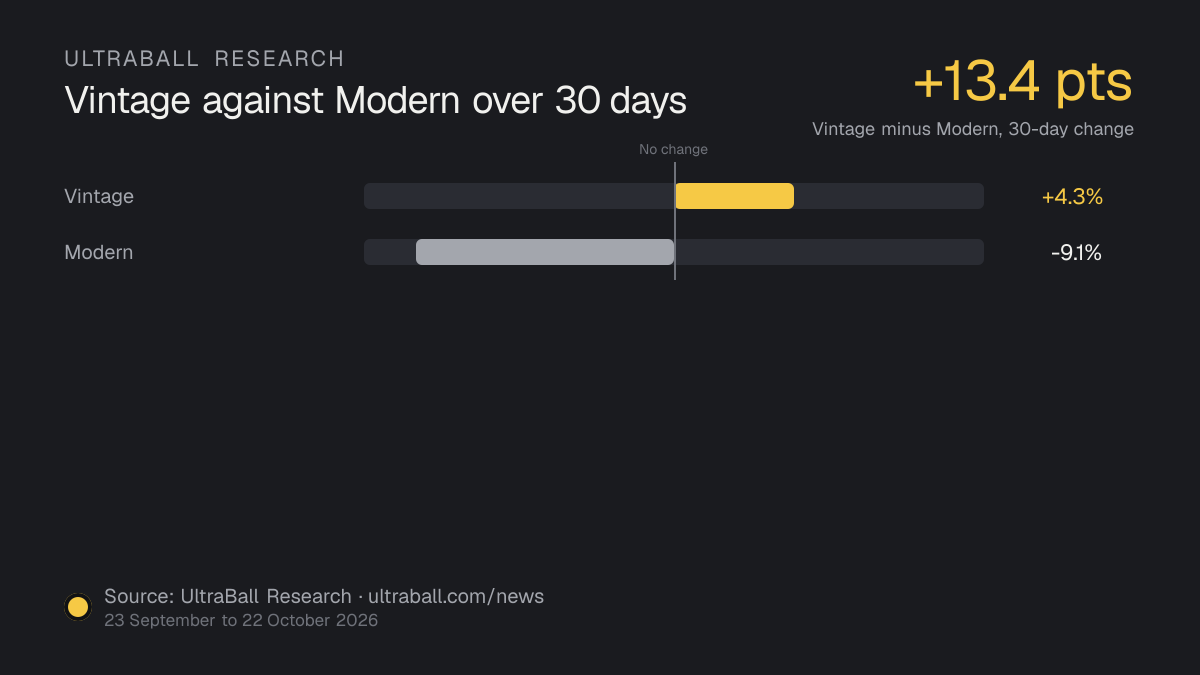
Two indexes, opposite directions
Vintage and Modern Pokémon cards moved apart between 23 September and 22 October 2026. UltraBall's Vintage index rose +4.3% over the period, while the Modern index fell −9.1%. That leaves vintage ahead by 13.4 percentage points.
The figures cover verified eBay US sales tracked by UltraBall, not every Pokémon card sale. The split is not new to this month: since 1 August the Vintage index is up +6.6% and the Modern index is down −13.8%. The Vintage index now sits at 106.6 and the Modern index at 86.2.

Price and sales activity are not the same story
Sales activity rose on both sides. Modern cards averaged 9,531 sales per collected day, up +28.0% on the 30 days before. Vintage (WOTC era) cards averaged 2,681 sales per collected day, up +7.7%.
For vintage, prices and activity moved together. For modern, they diverged: more cards changed hands per day while the index fell. Higher turnover alongside lower prices is consistent with more supply reaching the market, but the data here does not show listing volumes or seller behaviour, so it cannot say why modern prices weakened.
| Index | Card | Grade | Weight | 30 days |
|---|---|---|---|---|
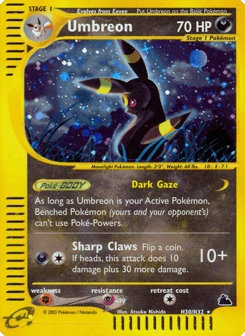
| Vintage | Umbreon (Skyridge H30) | PSA 10 | 5.0% | +51.9% |
| Vintage | Celebi (Skyridge 145/144) | PSA 10 | 4.4% | +10.0% |
| Vintage | Espeon (Aquapolis H9) | PSA 10 | 4.2% | +114.0% |
| Vintage | Kabutops (Skyridge 150/144) | PSA 10 | 3.8% | +337.1% |
| Vintage | Charizard (Base Set 4/102) | Ungraded | 3.8% | -18.3% |
| Modern | Mega Charizard X ex (Phantasmal Flames 125/94) | PSA 10 | 4.1% | -13.9% |
| Modern | Umbreon ex (Prismatic Evolutions 161/131) | PSA 10 | 3.8% | -13.9% |
| Modern | Mew ex (Paldean Fates 232/91) | PSA 10 | 3.7% | -10.0% |
| Modern | Umbreon VMAX (Evolving Skies 215/203) | PSA 10 | 3.6% | -8.4% |
| Modern | Mega Gengar ex (Ascended Heroes 284/217) | PSA 10 | 3.2% | -15.5% |
The cards carrying each index
The Vintage index leans heavily on late WOTC-era cards: Skyridge Umbreon (H30), Skyridge Celebi (145/144), Aquapolis Espeon (H9) and Skyridge Kabutops (150/144), alongside the perennial grail, Base Set Charizard (4/102). Skyridge and Aquapolis are e-Card era sets known for scarce holo and crystal-type cards that are difficult to find in high grade.
The Modern index's heaviest cards include Phantasmal Flames Mega Charizard X ex (125/94), Prismatic Evolutions Umbreon ex (161/131), Paldean Fates Mew ex (232/91), Evolving Skies Umbreon VMAX (215/203) and Ascended Heroes Mega Gengar ex (284/217). These are modern chase cards, many of them alt art or special illustration rares. The fact sheet does not give individual price changes for these cards, so their contribution to each index's move cannot be measured here.
What it means for collectors
For collectors, the split matters in two ways. Recent sold comps for modern chase cards sit lower than a month ago in UltraBall's index, while liquidity is higher: there are more sales to compare against each day.
Vintage remains the thinner market, with 2,681 sales per day against 9,531 for modern, but its index has held a steady upward line since 1 August. Index levels are recalculated as prices are restated, so these figures reflect the calculation on the day of writing.
What collectors should watch
- Whether modern sales per day stay elevated, and whether index prices steady or keep slipping alongside that activity.
- Supply of recent Mega Evolution-era chase cards such as Phantasmal Flames Mega Charizard X ex and Ascended Heroes Mega Gengar ex as more product is opened.
- Whether vintage activity keeps rising with prices, or whether thinner WOTC-era liquidity makes the Vintage index more sensitive to a few large sales.
- Restatements: index levels are recalculated as prices are restated, so check updated figures before comparing periods.
How this was worked out
Vintage is the 50 most traded Wizards of the Coast era cards (1999 to 2003); Modern the 50 most traded from Sword & Shield on. Both are 100 on 1 August 2026 (ub-index-5). Sales per collected day count verified eBay US sales of cards from those eras.
Index levels are recalculated as prices are restated; the figures are as calculated on the day of writing.
Every term is defined on UltraBall’s research methodology page, which also sets out the corrections policy.
Cite this research
Citation
UltraBall Research, “Vintage Pokémon Index Rises 4.3% as Modern Falls 9.1%, Opening a 13.4-Point Gap,” October 2026.
Suggested sentence
Over the 30 days to 22 October 2026, UltraBall's Vintage index rose 4.3% while its Modern index fell 9.1%.
Permanent link
https://ultraball.com/news/market/vintage-vs-modern-pokemon-cards-2026-10
- Author:
- UltraBall Research
- Published:
- 31 October 2026
- Data period:
- 23 September to 22 October 2026
- Dataset:
- UltraBall Vintage and Modern indexes
The figures in this article are fixed as of publication and kept with it. Live readings are on UltraBall Research; corrections are logged on the article.