Step 1: Find the set and the card number
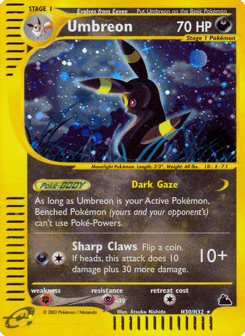
Start at the bottom edge of the card front. Almost every Pokémon card prints two things down there: a set symbol and a card number.
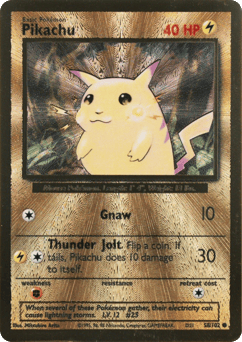
- The card number looks like "58/102". The first number is the card's position in the set, the second is the number of cards in the main set. Search with both and you'll usually land on exactly one card.
- The set symbol is a small icon, usually at the bottom right of the art box on older cards and at the bottom left of the card on newer ones. It tells you which expansion the card came from. Our set list shows every English set in release order, with its symbol and release date, and the set release dates guide lays out the same history year by year.
- Newer cards also print a small set code and a regulation mark near the bottom left, which makes sets easier to tell apart.
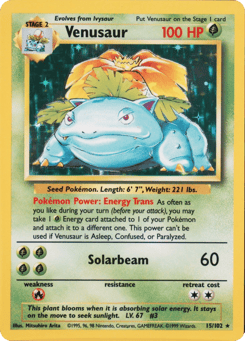
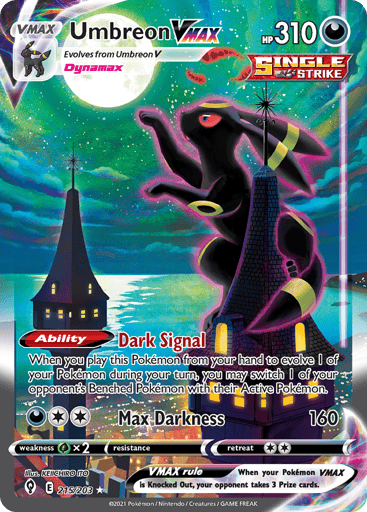
Some cards break the pattern, and they tend to be the interesting ones. The original Base Set from 1999 has no set symbol at all, so a card numbered out of 102 with no symbol is almost always Base Set. Secret rares carry a number higher than the set total: Umbreon VMAX (Evolving Skies) from Evolving Skies is numbered 215 out of 203. If your number is bigger than the total, slow down, because that's usually a secret rare and usually worth a proper look. Promo cards use their own numbering, often with a code such as "SWSH" or "SM" before the number, and belong to Black Star Promo sets like the SWSH Black Star Promos.
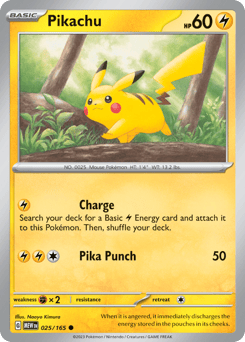
If you can't find the set, browse by Pokémon instead. Every Pokémon page lists all of its English cards with pictures, so a Charizard or Pikachu can be matched by eye in under a minute. It is the fastest route for anyone sorting a shoebox of mixed cards.
Step 2: Identify the printing
Once you have the right card, work out which version of it you're holding. This is where most people misjudge value, in both directions.
1st Edition
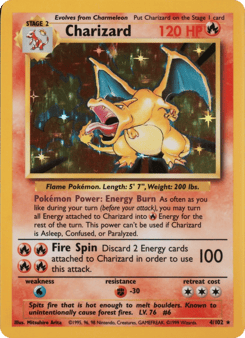
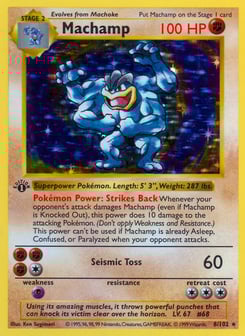
Cards from the first print runs of the early Wizards of the Coast sets carry a small black "Edition 1" stamp to the left, just under the artwork. A 1st Edition copy is a different item from the unlimited copy of the same card, with a different price. For example, Charizard (Base Set) has its own 1st Edition page with separate prices, and the gap between the two is large at every grade. Our guide to 1st Edition Pokémon cards shows where the stamp sits and which sets had it.
Shadowless
Early Base Set cards printed without the 1st Edition stamp but before a design change are called Shadowless, because the art box has no drop shadow along its right side. Hold one next to a later unlimited copy and the difference jumps out: the unlimited card has a dark shadow along the right edge of the art frame, the Shadowless one doesn't. They sit between 1st Edition and unlimited in price. See the Shadowless Charizard for an example, our Shadowless Pokémon cards guide for how to spot one, and the side-by-side of 1st Edition vs Shadowless vs Unlimited if you have all three and want to be sure.
Holo, reverse holo and non-holo
- A holo card has a foil (shiny) artwork.
- A reverse holo has foil across the rest of the card and a flat artwork.
- A non-holo card has no foil.
In most modern sets, holo, reverse holo and non-holo copies of the same card are priced separately, and the differences are usually small for commons and uncommons. Our explainer on what a reverse holo Pokémon card is covers the exceptions. For vintage holo rares such as Machamp (Base Set), the holo is the card; there is no reverse holo version. Most reverse holos from recent sets are bulk, so don't get excited about a shiny border on its own.
Rarity
The small symbol at the bottom of the card tells you its rarity: a circle for common, a diamond for uncommon and a star for rare. Newer sets add special rarities such as illustration rares and special illustration rares, which are worth more. Our Pokémon card rarity guide explains every symbol, the short version on how to tell if a Pokémon card is rare gets you there faster, and rarity pages such as special illustration rare list every card of that type with prices.
Step 3: Judge the condition honestly
The raw prices on Ultraball assume a clean, near-mint copy. Most cards that have been handled aren't near mint, and the price drops quickly as condition slips. This is the step people fudge, because nobody wants to admit their childhood binder was hard on its cards. Sellers usually use these terms:
- Near Mint (NM): looks unplayed. At most a tiny speck of whitening on a back edge.
- Lightly Played (LP): minor edge or corner wear, light scratches visible under a light.
- Moderately Played (MP): obvious whitening, scuffs, or a light crease.
- Heavily Played (HP): heavy wear, creases, or bends, still intact.
- Damaged: tears, water damage, writing, or large creases.
Check the card under a bright light, front and back. Look at the four corners, the edges of the back where the blue border shows wear first, and the surface of the artwork tilted at an angle so scratches catch the light. A creased or heavily played card may sell for a small fraction of the near-mint price, so price your card against the condition it's actually in, not the condition you remember it being in.
Step 4: Know whether you have a raw or graded card
A raw card is an ungraded card, loose or in a sleeve. A graded card has been sealed in a hard plastic case by a grading company such as PSA or CGC, with a grade from 1 to 10 on the label. Graded prices are separate from raw prices and depend heavily on the grade. The PSA grading scale explains what each number means, and how Pokémon card grading works covers the process behind the label.
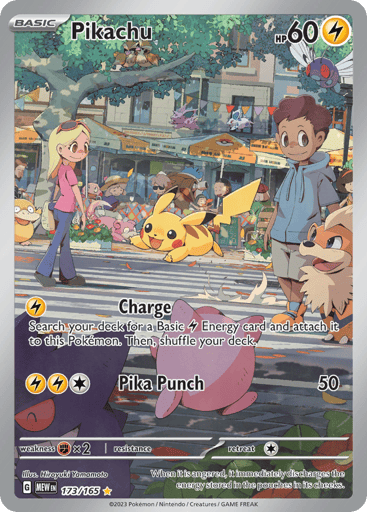
Take Pikachu (151) from 151. It sells for about $90.12 raw, about $99.00 as a PSA 9 and about $580 as a PSA 10. Three prices for one card, and the step from 9 to 10 is the one to watch. Each card page on Ultraball shows the raw price and the price at each PSA grade we have enough sales for.
For graded cards, check the certification number on the label with the grader's online lookup before you trust the grade. Fake slabs exist, and a real card in a fake case is still a fake listing. Our PSA 10 Pokémon cards guide covers what the top grade means and how to buy one safely.
Step 5: Use sold prices, not asking prices
The most common mistake is searching a marketplace and reading the prices on active listings. Asking prices are what sellers hope for. Many sit unsold for months at prices well above what buyers pay, and the same overpriced copy can sit there all year.
What a card is worth is what it recently sold for. That is what Ultraball is built on: card pages list the recent sold listings behind each price, after removing lots, bundles, non-English cards and mismatched card numbers. Graded prices come only from sales at that exact grader and grade. Every price carries a mark for how strong the evidence is, from strong to limited, so you can tell a well-traded card from one with only a few sales. You can read the full method on how we price.
Two more things to keep in mind:
- Prices move. Modern cards often drop in the months after a set releases as more packs are opened. Our market page shows which cards are rising and falling, and most traded shows where the volume is.
- Buyers and sellers see different numbers. A shop buying your card will usually offer well below the sold price, because it has to resell it. Selling yourself gets closer to the sold price but costs fees and time. Our guides on how to sell Pokémon cards and where to sell them weigh up the options.
When a card is worth grading
Grading makes sense when a high grade adds more value than the grading costs. As of September 2026, PSA's cheapest open service level is $59.99 per card, before shipping. So a card needs a large gap between its raw price and its PSA 9 or PSA 10 price, and it needs to be clean enough to earn one of those grades. Most cards fail on the second point, not the first.
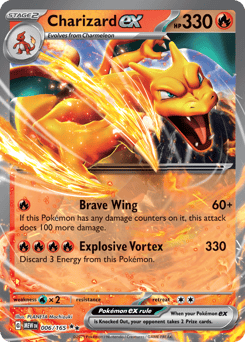
Charizard ex (151) shows the problem with grading cheap cards. It sells for about $10.02 raw and about $145 as a PSA 10. Take away the fee and shipping and a perfect grade barely covers the cost; anything less than a 10 loses money. Charizard ex (151), from the same set, sells for about $414 raw and about $1,425 as a PSA 10, which is a much stronger case if your copy is clean. Same Pokémon, same set, very different answer.
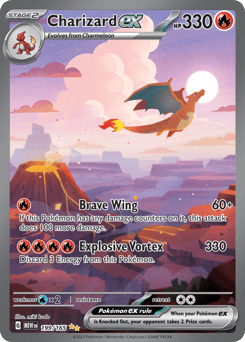
Our guide to PSA grading cost works through the break-even maths card by card, is it worth grading Pokémon cards covers the judgment calls, and how to get a Pokémon card graded walks through the submission itself. Phone apps that estimate grades can help you sort a pile, but read our look at AI grading apps before you trust one with a decision that costs money.
Cards people often get wrong
- Common doesn't mean cheap. Pikachu (Base Set) is a common, yet it sells for about $10.90 raw, and far more in top grades or as a 1st Edition.
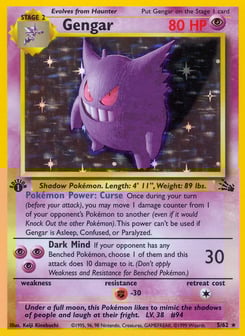
- Old doesn't mean valuable. Most Base Set, Jungle and Fossil commons and uncommons were printed in huge numbers and sell for very little unless they're 1st Edition or in gem condition. The holo rares are where the value is: Gengar (Fossil) sells for about $170 raw. Our guide to old Pokémon cards worth money goes through the Wizards era set by set.
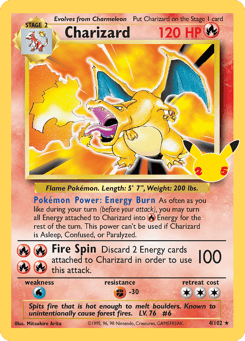
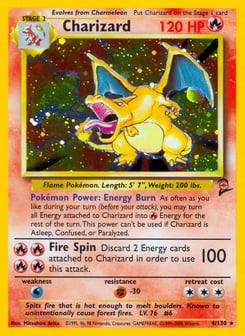
- Reprints look like originals. Many classic cards were reprinted in later sets such as Base Set 2, Legendary Collection and Celebrations: Classic Collection. The Charizard (Celebrations: Classic Collection) reprint sells for about $156, and Charizard (Base Set 2) for about $400. Both are real cards with real value, but neither is the 1999 original. Check the set symbol and number before you assume.
- Japanese and other languages are separate. Ultraball covers English cards. A Japanese card of the same Pokémon is a different card with a different price; see are Japanese Pokémon cards worth more and the note on Korean and Chinese cards.
If you think your card might be counterfeit, read how to tell if Pokémon cards are fake before you price it. And if you want to know which cards are worth looking for in the first place, start with Pokémon cards worth money, how to tell if Pokémon cards are worth money, and the most valuable Pokémon cards ranking.