
What 1st Edition means
When Wizards of the Coast launched the English game with Base Set in January 1999, the opening print run carried a 1st Edition symbol. Later runs of the same cards dropped it. Those later cards are called Unlimited because the print runs weren't capped, and they make up the large majority of vintage cards still out there.
PSA describes 1st Edition cards as "the first-ever cards printed" for a set and notes that they're typically more desirable than their Unlimited counterparts. The reason is plain supply. The 1st Edition run of Base Set was printed and sold before demand peaked, so fewer copies exist, and far fewer survived the playground in clean condition.
The stamp only matters on English cards printed by Wizards of the Coast, which held the English license from 1999 to 2003. Every main expansion in the Wizards era from Base Set to Neo Destiny had a stamped run, with one exception covered below. No English set since has used it.
How to tell if a Pokémon card is 1st Edition
Look for the stamp. It's a black circle with the numeral 1 inside and the word EDITION arching over the top. CGC describes it as "the number '1' on a solid black circle" with EDITION in capital letters. If it's there and genuine, the card is 1st Edition. If not, the card is Unlimited, or on Base Set it may be Shadowless.
Where the stamp sits depends on the card type:
- Pokémon cards: on the left edge, just below the lower-left corner of the artwork box.
- Trainer cards: in the bottom-left corner.
- Energy cards: in the top-right corner.
People miss stamps on Energy cards all the time because they look in the wrong corner. On a Double Colorless Energy or any basic Energy, check the upper right. On a Trainer such as Professor Oak (Base Set), look at the bottom left, and on a Pokémon card like Pikachu (Base Set), look just under the art. The images below show where each spot is on a Base Set card.
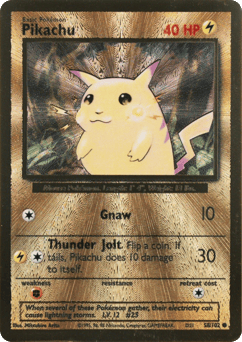


On Base Set there's a second check that backs up what the stamp tells you. PSA notes that 1999 Base Set 1st Edition cards also have a thinner HP font and no drop shadow on the right side of the artwork border. So a Base Set Pokémon card with the stamp should also be shadowless. A stamp plus a drop shadow is a contradiction, and that combination is the most common sign of a faked stamp. Our guide to 1st Edition vs Shadowless vs Unlimited puts the three printings side by side if you want to practice on the differences.
Which sets have 1st Edition cards
Ten English expansions were printed with a 1st Edition run. Dates below are English release dates from our set list, and each set links to its full card list with prices.
| Set | English release | 1st Edition run |
|---|---|---|
| Base Set | January 9, 1999 | Yes |
| Jungle | June 16, 1999 | Yes |
| Fossil | October 10, 1999 | Yes |
| Base Set 2 | February 24, 2000 | No |
| Team Rocket | April 24, 2000 | Yes |
| Gym Heroes | August 14, 2000 | Yes |
| Gym Challenge | October 16, 2000 | Yes |
| Neo Genesis | December 16, 2000 | Yes |
| Neo Discovery | June 1, 2001 | Yes |
| Neo Revelation | September 21, 2001 | Yes |
| Neo Destiny | February 28, 2002 | Yes |
Base Set 2 was a reprint set that combined cards from Base Set and Jungle, and CGC names it as the only set in that stretch without a 1st Edition run. CGC also notes that Pokémon hasn't issued English cards with a 1st Edition stamp since Neo Destiny. That rules out Legendary Collection, the e-Card sets starting with Expedition, and every set since. The full order of English sets is in our Pokémon set release dates guide.
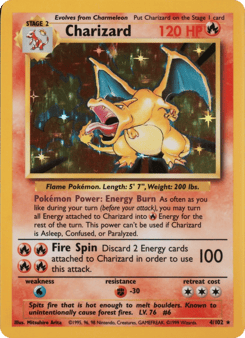
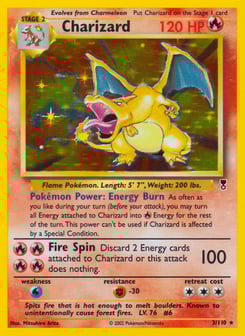
So a stamp on any card from those later sets is either a misread of some other symbol or an alteration. The Charizard reprints are the classic trap: Charizard (Base Set 2) and Charizard (Legendary Collection) use the same artwork as the Base Set card, and neither was ever printed with a stamp. Modern promos sometimes carry other stamps, such as prerelease or event marks, but none of them is the Edition 1 circle.

1st Edition vs Shadowless vs Unlimited
Base Set is the only set with three distinct printings that collectors separate. The other nine stamped sets have two: 1st Edition and Unlimited.
| Printing | Edition 1 stamp | Drop shadow on art box | HP font | Relative scarcity |
|---|---|---|---|---|
| 1st Edition | Yes | No | Thin | Scarcest |
| Shadowless | No | No | Thin | Scarce |
| Unlimited | No | Yes | Bold | Common |
CGC and PSA describe the same order. The first print run had the stamp. The second run removed the stamp but kept the shadowless art box and thin HP font. Later runs added the drop shadow on the right side of the art box and thickened the HP text. A small 2000 print run, usually called the 4th print or UK print, has a copyright line ending in 1999-2000. CGC grades 1st Edition and Shadowless Base Set cards in separate population categories for exactly this reason.
The short version: every Base Set 1st Edition card is shadowless, but most shadowless cards aren't 1st Edition. Our Shadowless Pokémon cards guide covers the middle printing and its tells in detail.
1st Edition Charizard
The 1st Edition Charizard (Base Set) is the reference card for the whole vintage market. Its stamped printing, 1st Edition Charizard (Base Set), has its own sold-price history, separate from the Shadowless Charizard (Base Set) and the Unlimited card.
At the top of the grading scale the numbers leave the rest of the hobby behind. In December 2025 Heritage Auctions sold a PSA 10 1st Edition Base Set Charizard for $550,000 including buyer's premium. Heritage called it a record for the card at public auction, and noted it was one of 125 copies PSA had graded Gem Mint 10 at the time.
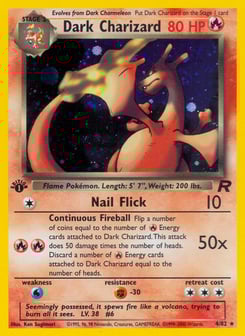
Lower grades are where most of the sales actually happen. Condition matters more than usual on this card, because the holo surface shows every scratch and the dark blue back shows every bit of edge wear. Hold one under a desk lamp and tilt it before you pay for it. Our Charizard hub and the most valuable Charizard cards ranking put the 1st Edition copy next to the later stamped Charizards that compete with it, Blaine's Charizard (Gym Challenge) and Dark Charizard (Team Rocket).
1st Edition Pokémon cards value: what they're worth
The stamp multiplies whatever the card is already worth. It doesn't turn a common into a valuable card on its own. A stamped holo from a popular set is where the money is. A stamped common in played condition usually sells for little more than the Unlimited copy, and if you're hoping a stack of 1st Edition commons will pay for something, lower your expectations now. Our guide to old Pokémon cards worth money covers the rest of a 1999 shoebox, and what makes a Pokémon card valuable explains the other factors in play.
Base Set holos
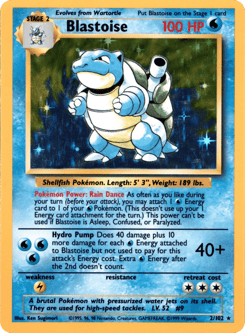
After Charizard, the other two starters lead Base Set. Blastoise (Base Set) sells for about $158 as an Unlimited copy, and its stamped version is on 1st Edition Blastoise (Base Set). Venusaur (Base Set) follows the same pattern, with the stamped copy at 1st Edition Venusaur (Base Set). The most valuable Base Set cards ranking shows the full order.
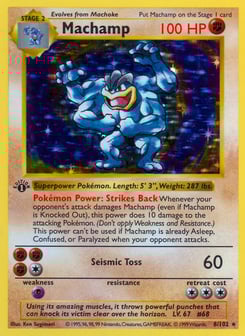
Machamp (Base Set) is a useful check on how much the stamp adds by itself. An Unlimited copy runs about $72.91; compare that with 1st Edition Machamp (Base Set) to see the premium on a holo with less demand than the starters.

Jungle, Fossil and Team Rocket
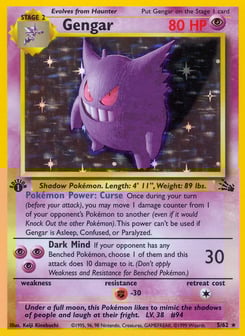
These sets had a 1st Edition run but no Shadowless variant, so the stamp is the only printing distinction that matters. In Jungle, Flareon (Jungle) is about $68.77 Unlimited, and Snorlax (Jungle) is the chase holo, with its stamped copy on 1st Edition Snorlax (Jungle). In Fossil, Dragonite (Fossil) runs about $132 Unlimited and about $6,500 in PSA 10, while Gengar (Fossil) is the fan favorite; more of both are on the Dragonite and Gengar pages. Team Rocket's Dark Charizard sells for about $327 Unlimited and about $10,800 in PSA 10, with the stamped version on 1st Edition Dark Charizard (Team Rocket).
Gym and Neo sets
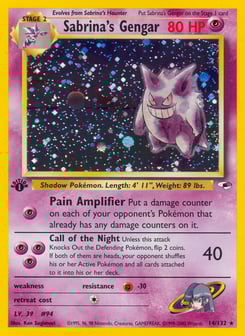
The Gym sets introduced trainer-owned Pokémon. Sabrina's Gengar (Gym Heroes) is the top card in Gym Heroes at about $499 Unlimited, and Blaine's Charizard in Gym Challenge sells for about $582. The stamped Gym Challenge card is on 1st Edition Blaine's Charizard (Gym Challenge).
The Neo sets produced some of the most expensive stamped cards outside Base Set. Lugia (Neo Genesis) sells for about $598 as an Unlimited card, and its stamped copy is on 1st Edition Lugia (Neo Genesis). Our Lugia hub has the rest of its cards. Umbreon (Neo Discovery) from Neo Discovery runs about $669 Unlimited and about $26,099 in PSA 10; the rest of the Umbreon cards are on their own page.
The Shining Pokémon from Neo Revelation and Neo Destiny close out the era. Shining Gyarados (Neo Revelation) sells for about $1,126 Unlimited, and Shining Tyranitar (Neo Destiny) for about $1,061. Shining Charizard (Neo Destiny) is the headline card of the last stamped set, with its 1st Edition copy on 1st Edition Shining Charizard (Neo Destiny). More on these is on the Shining rarity page and in the most valuable Neo Destiny cards ranking.
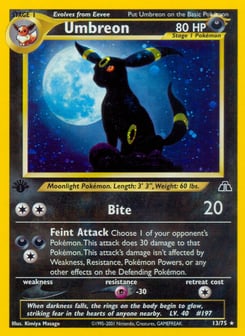
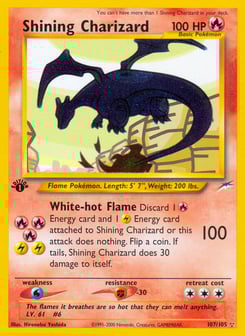
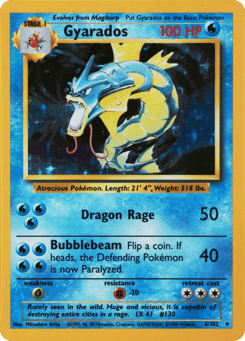
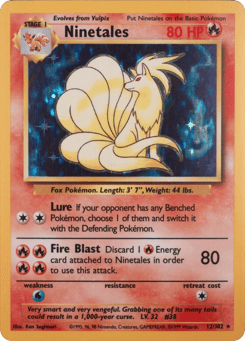
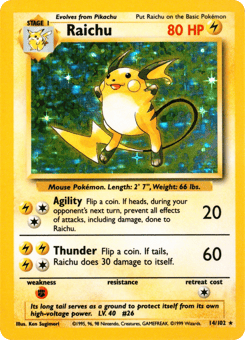
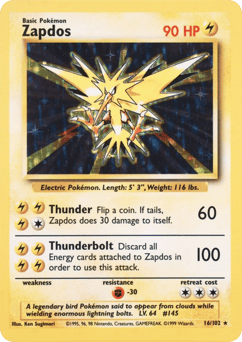
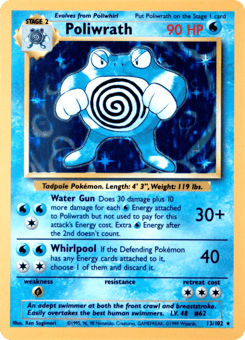
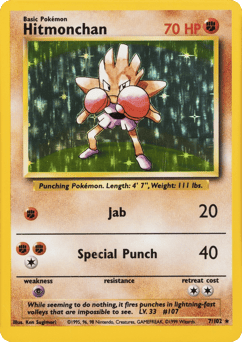
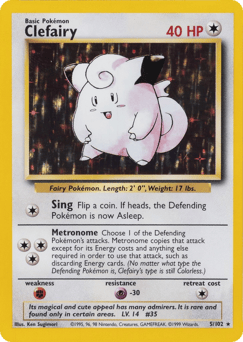
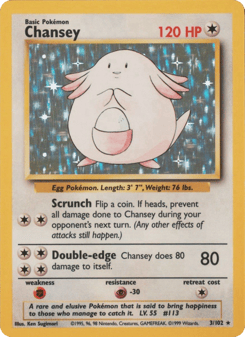
The live list below ranks 1st Edition printings by today's recorded sold prices, so you can see which stamped cards are worth the most right now.
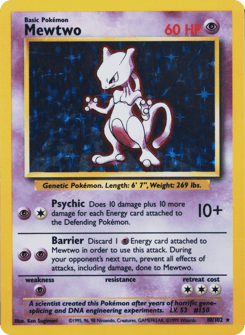
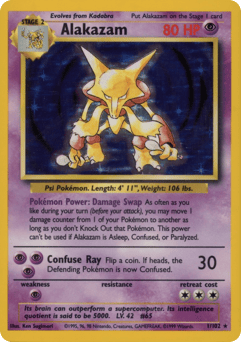
For the wider picture, compare this list with the most valuable 1999 Pokémon cards and the rarest Pokémon cards. If you want to price a whole stack rather than one card, our guide on how much your Pokémon cards are worth is quicker.
How to spot a fake 1st Edition stamp
Because the stamp can multiply a card's value, fakers target it. They either add a stamp to a genuine Unlimited card or print the whole card, stamp included. These checks catch most of them:
- Shadow and stamp together. On Base Set, a stamped Pokémon card with a drop shadow on the right of the art box isn't a real 1st Edition card. The genuine run was shadowless.
- HP font. A stamped Base Set card with the bold Unlimited HP text is wrong for the same reason.
- Wrong set. A stamp on Base Set 2, Legendary Collection, or anything after Neo Destiny isn't genuine.
- Wrong position. The stamp belongs on the left under the art on Pokémon cards, bottom left on Trainers, and top right on Energy. A stamp floating in the art or the text box is a red flag.
- Print quality. A real stamp is printed as part of the card, flat and crisp. Raised ink, a glossy stamp on a matte area, or a slightly different black are signs it was added later. A loupe helps here.
Then run the usual checks for counterfeit cards: card stock, the light test, font and color. Our guide on how to tell if Pokémon cards are fake walks through each one. For expensive cards, buying a copy already graded by PSA or CGC moves the authentication risk to the grader, and that's what we'd do for anything in four figures.
Japanese 1st Edition marks
Japanese cards used a different system. According to CGC, Japanese first print runs carried a 1st Edition mark from 2001 until 2016. It shows a large 1 above the word EDITION, sits in the lower-right corner of Pokémon and Trainer cards, and never appeared on Japanese Energy cards. It doesn't look like the English stamp, so don't judge one by the other. This guide, and our prices, cover English cards; our guide on whether Japanese Pokémon cards are worth more covers the other side.
Should you grade a 1st Edition card?
Grading makes sense when the gap between the raw price and a high-grade price is wider than the fee plus shipping. That's usually true for 1st Edition holos in clean condition and usually false for stamped commons with worn corners. Check the card's printing page for its graded prices, then compare against current fees in our PSA grading cost guide. The PSA 10 Pokémon cards guide explains why the top grade pulls so far ahead of a 9, and is it worth grading Pokémon cards runs through the decision card by card.