
The three print runs, in order
Wizards of the Coast printed Base Set several times, and each run left its fingerprints on the cards.
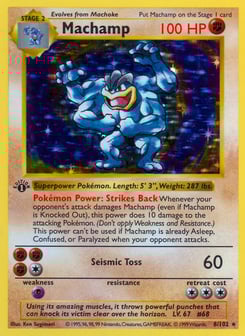
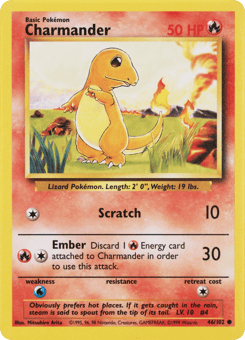
- 1st Edition. The first run. A small black "Edition 1" stamp sits at the lower left of the artwork box. These cards have no drop shadow and a thin HP font.
- Shadowless. The second run. Wizards dropped the stamp but kept everything else, so the art box still has no shadow and the HP is still thin. CGC calls the first two runs the Limited Edition printings and grades them as separate categories.
- Unlimited. The mass-market run. A gray drop shadow appears along the right side of the art box, and the HP text gets heavier. This is the printing that fills most childhood binders.
There's a fourth run collectors mention: a 2000 printing, often called the UK print, that looks like Unlimited but has a copyright line reading 1999-2000. For value purposes it's an Unlimited card with a footnote.
So yes, every 1st Edition Base Set card is also shadowless. Collectors just don't say "1st Edition Shadowless", because the stamp already tells you which run it came from, and "Shadowless" on its own has come to mean the unstamped second run.
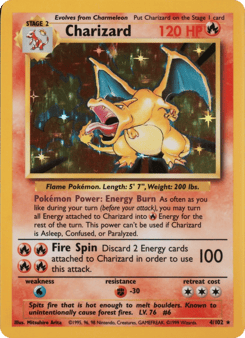
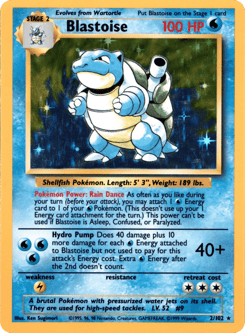
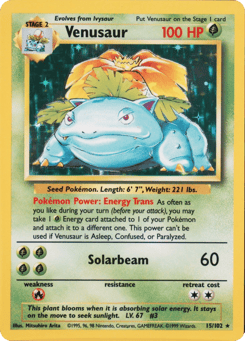
The three starters above, Charizard (Base Set), Blastoise (Base Set) and Venusaur (Base Set), each have a 1st Edition, a Shadowless and an Unlimited version with their own sales history. Ungraded Unlimited Blastoise sells for about $158. Compare that with 1st Edition Blastoise (Base Set) and Shadowless Blastoise (Base Set) and you'll see the whole story of this page in three prices.
Side by side: how to tell them apart
| Detail | 1st Edition | Shadowless | Unlimited |
|---|---|---|---|
| "Edition 1" stamp below the art, left side | Yes | No | No |
| Drop shadow down the right side of the art box | No | No | Yes |
| HP font | Thin | Thin | Bold |
| Copyright line | ©1995, 96, 98, 99 | ©1995, 96, 98, 99 | ©1995, 96, 98 |
| Sets it exists for | Base Set to Neo Destiny | Base Set only | Every Wizards set |
The copyright line is the tell we'd trust most. Beckett calls the extra 99 the clearest and most consistent identifier on the card, and it works on Trainers and Energy too, where there's no Pokémon art box to judge a shadow against. Shadows are easy to misjudge in a dim listing photo. A printed number isn't.
Which one is worth the most
1st Edition, then Shadowless, then Unlimited, every time for the Base Set holos. PSA puts it the same way: Shadowless cards are usually more desirable than Unlimited but fall second to 1st Edition. The gaps are bigger than most people expect, though, and they're not even.
Across Base Set cards where we have enough recorded sales of each printing, the median near-mint 1st Edition copy sells for more than ten times its Unlimited twin. The median Shadowless copy sells for a bit under twice Unlimited. That makes 1st Edition roughly seven times Shadowless at the median. In other words, the jump from Unlimited to Shadowless is real but modest; the stamp is where the money is.
Charizard shows it most. An Unlimited Charizard (Base Set) in a PSA 9 sells for about $3,950 and in a PSA 8 for about $1,400. The Shadowless Charizard (Base Set) and 1st Edition Charizard (Base Set) pages sit at a different level entirely, and the 1st Edition PSA 10 is one of the most expensive English cards ever sold (see most expensive Pokémon cards ever sold). Browse every version on our Charizard page.
There's one well-known oddball. Machamp (Base Set) sells for about $72.91 Unlimited, and in our sales the 1st Edition Machamp (Base Set) copy sells for no more than that. The stamp doesn't lift every card, so check the printing page before you get excited about a stamped Machamp.
Commons follow the same order at a lower level. An Unlimited Charmander (Base Set) is about $2.25, and its Shadowless and 1st Edition copies step up from there. The full ranking lives on most valuable Base Set cards.
Only Base Set has all three
Shadowless is a Base Set term and nothing else. Jungle, Fossil, Team Rocket, the two Gym sets and the four Neo sets were printed in just two versions: 1st Edition and Unlimited. The 1st Edition stamp stopped after Neo Destiny in 2002, so nothing English from later sets carries it.
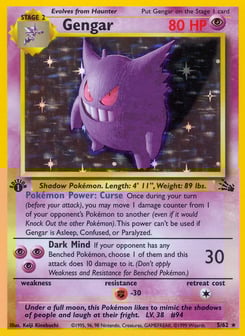
The premium is also much smaller outside Base Set. For Jungle, Fossil, Team Rocket, Gym Heroes and Neo Genesis, the median 1st Edition card in our sales sells for about double its Unlimited copy. Gengar (Fossil) sells for about $170 Unlimited and Flareon (Jungle) for about $68.77; their stamped versions are worth a solid step up, not a tenfold one. Base Set's first run is simply in a league of its own. Our Wizards of the Coast era page has every set from the period.
The same goes for foreign-language cards. Beckett notes that French, German, Italian and Spanish Base Set cards were printed with the shadow from the start, so a "Shadowless" French Charizard listing is a mistake or a trick.
Reprints that get mistaken for all three
Three sets reprinted Base Set art, and all three turn up in "1st Edition?" questions.
- Base Set 2 (2000). Has a small set symbol at the bottom right of the art and is numbered out of 130 instead of 102. It was never printed with a 1st Edition stamp. Charizard (Base Set 2) sells for about $400 ungraded.
- Legendary Collection (2002). Came out after Neo Destiny, so it has no 1st Edition run either. It has its own set symbol and is numbered out of 110. Its Charizard is Charizard (Legendary Collection).
- Celebrations: Classic Collection (2021). Modern reprints of Base Set favorites. Charizard (Celebrations: Classic Collection) sells for about $156, a fraction of a real 1999 holo.
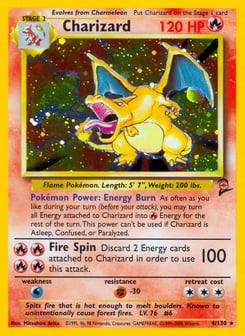
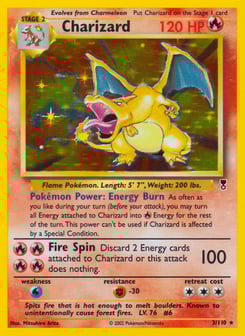
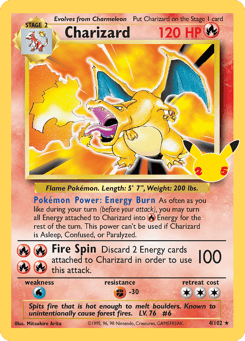
If your card has any set symbol at the bottom right of the art box, it isn't Base Set, and the whole 1st Edition vs Shadowless question doesn't apply.
Identify yours in 30 seconds
Work through this in order, with the card under a good light.
- Is it Base Set? No set symbol under the right side of the art box, and a number out of 102. If it has a symbol, go to its set page instead.
- Look for the stamp. A small black circle with a "1" and the word EDITION, just under the lower left corner of the art. Stamp = 1st Edition.
- No stamp? Check the shadow. A gray band down the right edge of the art box = Unlimited. None = possibly Shadowless.
- Confirm with the copyright line. Ends in 99 = Shadowless (or 1st Edition). Ends in 98 = Unlimited, whatever the shadow looked like.
- Check the HP. Thin = early run, bold = Unlimited. If the HP and copyright line disagree with each other, stop and suspect an altered or fake card.
Fakes and doctored stamps are a real problem at the top end. If a card is 1st Edition or Shadowless and worth serious money, read how to tell if Pokémon cards are fake before you buy or sell it, and use our price checker guide to find the exact printing page.
Does the printing change whether you should grade?
It changes the maths a lot. A clean Shadowless or 1st Edition holo carries a premium at almost every grade, so grading tends to pay even when the card comes back a 6 or 7. An Unlimited common with soft corners almost never pays. Graders also record the printing on the label, which settles the identification question for any future buyer.
Run your card through is it worth grading Pokémon cards and check current fees in PSA grading cost. If you're new to the numbers on the slab, the PSA grading scale explained covers what a 6 versus an 8 means for a card this old. For the wider picture of what vintage cards fetch, see old Pokémon cards worth money.