
Quick checklist: how to tell if a Pokémon card is fake
- Compare the back with a real card. This is the most reliable check.
- Read every word on the front for spelling, grammar and a missing accent on "Pokémon".
- Check the font, the font size and the text colors.
- Compare the colors and ink against a real copy or a clear scan.
- Look at the energy symbols: size, centering and color.
- Check the holo pattern and any texture on full-art cards.
- Look at the border width, the size and the cut of the edges.
- Feel the card: thickness, stiffness, weight and surface finish.
- Try the light test, next to a real card of the same type.
- Look up the exact card and compare every number on it.
If the card is graded, there's one more job: verify the slab and the certificate number. That gets its own section below.
1. Compare the back of the card
Every English Pokémon card from 1999 to today uses the same card back, with a handful of documented exceptions. That makes the back the best comparison point you have, and it's the first check TCGplayer's authentication team uses. Put the suspect card next to any real English card, from a 1999 Wizards of the Coast holo to a current Mega Evolution common, and look closely.
On a real card, the dark blue border is a distinct shade, clearly separate from the swirls of lighter blue inside it. The Poké Ball is crisp and the red is saturated. On fakes, the blues often bleed into each other, the colors look washed out or drift toward purple, and the edges of the swirl pattern go soft. If you're buying online and the seller won't show you the back, treat that as a warning and move on.
2. Read every word on the card
This is the fastest check, and it catches a lot of low-effort fakes:
- The accent in "Pokémon". Real English cards always print the é. A missing accent is close to a guarantee the card is fake.
- Spelling and grammar. Real cards are carefully proofread. Typos, odd phrasing and attack text that refers to a different Pokémon are giveaways. Cardmarket's counterfeit guide shows a fake Mewtwo whose attack text still names Zapdos.
- Impossible details. There's no such thing as a "2nd Edition" Pokémon card. A Basic Pokémon listed as evolving from something else, HP or damage in the thousands, or "Pocket Monster" in place of "Pokémon" all mean a fake.
On its own this check isn't very reliable, because many fakes copy a real card's text exactly. But when a card fails it, you're done. Pull up the real Mewtwo (Base Set) and Zapdos (Base Set) and read their attack text; a fake that borrows words from the wrong card stands out once you look for it.
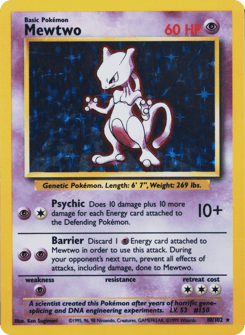
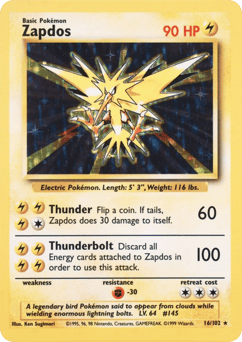
Don't confuse fakes with genuine misprints, either; real error cards exist and some sell well, which is a separate topic covered in our guide to Pokémon error cards worth money.
3. Check the font and text colors
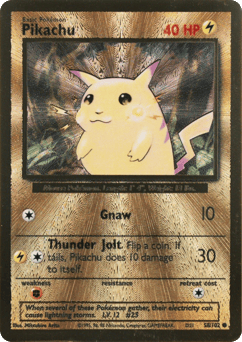
Pokémon cards use a consistent set of typefaces, and counterfeiters rarely match them. Look at the Pokémon's name, the HP, the attack names and the small print along the bottom. Letters on a fake are often too thin, too bold, a touch the wrong size or unevenly spaced. Text colors should match the real card too. Card names are not printed in green, and HP is not printed in red.
Do this side by side with a real card from the same set. The typography on a Base Set card is different from a Sword & Shield card, so compare like with like. A 2021 card will make a real 1999 card look "wrong", and that's not what you want to learn. Here's the kind of gap you're looking at: a 1999 Pikachu (Base Set) next to Charizard V (Brilliant Stars) from 2022.

4. Compare the colors and print quality
Real cards are printed with bright, saturated colors and sharp detail. Fakes are often dull, washed out or oversaturated, with blurry artwork where someone scanned a real card and reprinted it. Look at the artwork under good light:
- Fine lines in the illustration should be sharp, not smudged.
- Shadows and gradients should look smooth, without banding.
- The yellow border should match the shade on a real card from the same era.
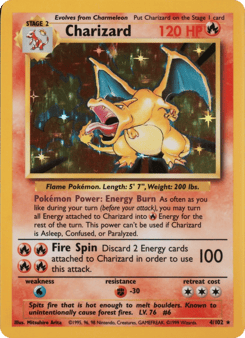
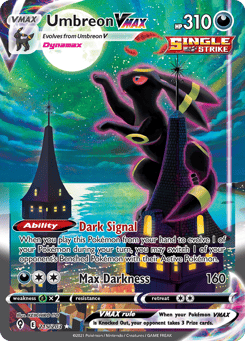
A high-resolution image of the real card is enough for this check. Every card page on Ultraball shows the card with its set and number, so you can pull up Charizard (Base Set) or Umbreon VMAX (Evolving Skies) and compare the colors directly on your screen. These two get faked constantly, so they're worth knowing by sight.
5. Look closely at the energy symbols
Energy symbols show up in the attack costs, weakness, resistance and retreat cost. On a real card each symbol is a clean circle with the icon centered and sized consistently. On fakes, the icon inside the circle is often too large, off-center or the wrong color. Cardmarket calls this out as a common, clear sign of a counterfeit.
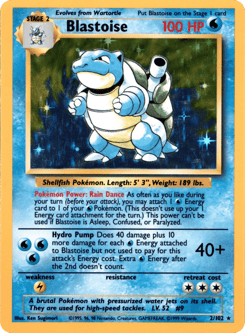
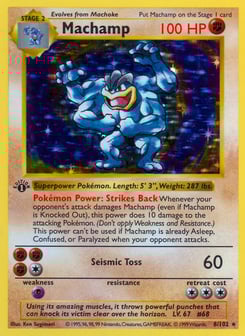
Check the attack costs against a real copy while you're there. A fake sometimes shows the wrong number of energy or the wrong type altogether. Vintage holos such as Blastoise (Base Set) and Machamp (Base Set) are good ones to practice on, because the energy circles are large and the real ones are very clean.
6. Check the holo pattern and texture
Foil is expensive to copy well, which makes it one of the best tests for rare cards.
- Vintage holos. On Wizards-era holo rares the foil sits only in the artwork box, with a specific pattern for each era. A holo pattern that covers the whole card, or a flat rainbow sheen with no pattern, is wrong for a card like Base Set Charizard.
- Reverse holos. The foil should cover everything except the artwork, not the other way around. If you're not sure what a real one looks like, our guide to what a reverse holo Pokémon card is has examples.
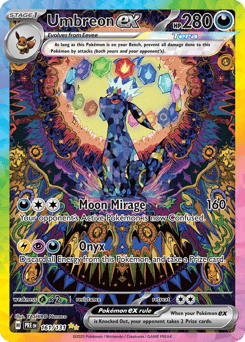
- Full arts and modern ultra rares. GX, V, VMAX and most Scarlet & Violet full-art cards, from Ultra Rares up to Special Illustration Rares, have a raised, etched texture you can feel with a fingertip. Fakes are almost always smooth and glossy. Rare misprints of real cards can lack texture, so use this alongside the other checks, not instead of them.
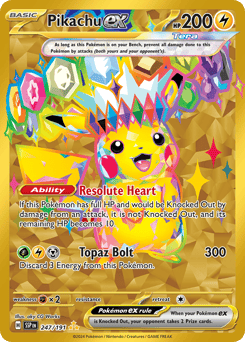
- Gold borders. Gold borders appear only on specific cards, such as gold secret rares and Hyper Rare cards. A gold version of a card that was never printed in gold is fake. Our Pokémon card rarity chart lists which rarities use which finishes, and our guide on whether gold Pokémon cards are worth anything covers the metal novelty cards sold online.
Fakes of high-value full-art cards, such as Charizard ex (151) or Umbreon ex (Prismatic Evolutions), often show a foil pattern that looks printed on rather than part of the card, with no depth when you tilt it. If you're checking a gold card, compare it with a real one such as Pikachu ex (Surging Sparks).

7. Check the borders, size and edges
Look at the border on each side. Real cards are often off-center, and a slightly thicker border on one side is normal; graders knock points off for it, but it doesn't make a card fake. What isn't normal is a border that's dramatically wide, uneven along a single edge, or a card that's visibly the wrong size next to a real one. Stack the suspect card on top of a real card and square up two corners. If the other two corners don't line up, you have your answer. Our guide to Pokémon card dimensions has the standard size if you want to measure.
The edges themselves should be clean and straight. Fakes can have rough, fuzzy or slightly wavy cuts, and sometimes loose fibers along the edge.
8. Feel the card: weight, thickness and finish
Once you've handled a few hundred real cards, a fake often feels wrong before you can say why. The usual tells:
- The card is noticeably thinner, floppier or stiffer than a real one.
- The surface is overly glossy, like a photo print, and throws glare under a lamp.
- The card is noticeably lighter or heavier than a real card from the same era.
You don't need to bend a card to judge its stiffness. Your fingers can tell. Compare it with a real card of the same era and finish, since holo, reverse holo and full-art cards all feel slightly different in the hand. If you have a small kitchen scale, weighing a suspect card against a real one of the same type is a reasonable extra check, but don't treat a small difference as proof.
9. The light test (use it with care)
Shine a phone flashlight through the card in a dim room. Real cards have a dark core layer that blocks much of the light, while many cheap fakes let it glow through evenly. The Pokémon Company's own support page mentions this test, and it's a useful quick screen when you're sorting a stack.
It also throws false alarms. Real cards from different eras and with different foils let through different amounts of light, so a modern full art and a 1999 holo won't behave the same. Only compare against a real card of the same type, under the same light, held the same distance away. If the suspect card glows and the real one doesn't, that's a strong sign. If both glow a little, you've learned nothing.
Tests to skip
The rip test. Real Pokémon cards are two layers of paper stock with a dark layer in between, and tearing a card shows that layer. It works, but it destroys the card. Only consider it for a bulk card you already believe is fake and don't care about. Never rip a card that might be real.
The bend test. Bending a card to see whether it springs back damages real cards too. Skip it.
10. Look up the exact card and check every number
Find the exact card in a reliable database and compare the details one by one: the HP, attack names and damage, weakness, resistance, retreat cost, set symbol, collector number and rarity symbol. The quickest way on Ultraball is to search the card name on our card list or browse the set from our sets page. Each card page shows the card image, the set, the collector number and what it sells for (prices come from recorded sold listings, as explained on how we price).
Watch for mismatches: a set symbol from one expansion with a collector number from another, a rarity symbol that doesn't exist for that card, or a holo version of a card that was only printed non-holo. If you're checking a vintage card, our guides to 1st Edition Pokémon cards and shadowless Pokémon cards explain which printings exist, and 1st Edition vs Shadowless vs Unlimited shows the three side by side. A "1st Edition" stamp on a set that never had a 1st Edition run is fake, full stop.
How to spot a fake graded card
Counterfeit slabs are a separate problem, and a nastier one, because the money involved is bigger. Some are a counterfeit card sealed in a copied holder with a real certificate number lifted from a genuine slab. Others are real holders that were opened and resealed with a different card inside.
- Look up the certificate number. Enter it on the grader's own website: PSA's cert verification or CGC's cert lookup. The card, set, year and grade must match the label exactly.
- Compare the card to the grader's images. For many recent submissions, the cert page shows photos of the actual card. Centering, print lines and small marks should match the card in front of you. A valid number with a different card inside means the slab is fake or has been tampered with.
- Check the holder. Compare the label font, hologram, logo and plastic against a slab you know is real. Fake labels often have slightly different fonts, spacing or colors, and fake cases can feel lighter or show seams and bubbles.
- Be wary of prices far below the market. A PSA 10 listed well under recent sales is the most common setup for a fake slab. Check what the grade actually sells for on the card's page, or in our recent top sales, before you buy. Our guide to PSA 10 Pokémon cards shows where the top grades trade, and how Pokémon card grading works explains what's on a real label.
How to avoid buying fakes
- Know the price. If a card is listed far below what it sells for, ask why. The Pokémon Company's support team makes the same point about sealed product priced well under retail. Our price checker guide shows how to look up recent sales for any card.
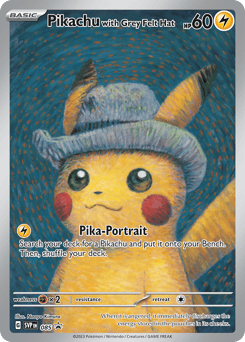
- Be extra careful with popular, high-value cards. Counterfeiters fake what sells: Charizard, Pikachu, Umbreon, modern alternate arts from sets like Evolving Skies and 151, and vintage holos. High-demand promos such as Pikachu with Grey Felt Hat (Scarlet & Violet Black Star Promos) are targets too. Browse the most valuable Charizard cards and you'll see which ones are worth faking.
- Ask for the back and a tilted photo. Online sellers should show the back, the edges and the foil at an angle. A seller with real cards has no reason to refuse.
- Buy sealed product from trusted sellers. The Pokémon Company says it receives the most reports of counterfeit sales from flea markets. Real booster boxes are wrapped in a soft, printed cellophane with the Poké Ball logo, and real packs are sealed flat and snug around the cards.
- Check packaging text. Fake sealed product often references a different set, uses anime screenshots instead of card art, names Nintendo or Pokémon USA, or shows Ash Ketchum. Cardmarket notes that Pokémon USA, Inc. has not existed since 2009, so newer product carrying that name is fake.
The cards below are the kind that get counterfeited most: a sought-after promo, a Charizard (Charizard-GX (Hidden Fates Shiny Vault)) and a modern chase card. Know what the real ones look like before you pay for one.

What to do if you bought a fake
If you bought through a marketplace, report the card through its buyer-protection process straight away and keep all packaging and photos. Most large marketplaces, such as eBay and TCGplayer, offer buyer protection for items that aren't as described. If you bought in person, take the card and a real copy back to the seller, or to a local card shop that can confirm it. Counterfeit cards can't be used at official events and have no resale value as real cards, so don't pass one on. When you do sell real cards later, our guide on how to sell Pokémon cards covers the photos buyers will expect.