Pokémon card size at a glance
| Measurement | Width | Height |
|---|---|---|
| Inches | 2.5 in (2½ in) | 3.5 in (3½ in) |
| Millimeters | 63 mm | 88 mm |
| Centimeters | 6.3 cm | 8.8 cm |
| Exact conversion of 2.5 × 3.5 in | 63.5 mm | 88.9 mm |
Why two metric figures? Dragon Shield's size guide gives standard cards as 63 × 88 mm (2½ × 3½ in) and lists Pokémon among the games that size fits. Ultra Pro describes the same cards as 2-1/2 × 3-1/2 inches and converts that exactly to 63.5 × 88.9 mm. The difference is under a millimeter, and every standard-size accessory is made to fit either way.
The shape works out to a 5:7 ratio, the same proportions as a 5 × 7 inch photo print.
Is every Pokémon card the same size?
Every regular card in a booster pack is. A 1999 Base Set holo and a 2025 special illustration rare are the same size, and so is every rarity in between: commons, holos, full arts, ex, V, VMAX and VSTAR cards. Rarity changes the foil, the texture and the art, never the dimensions.
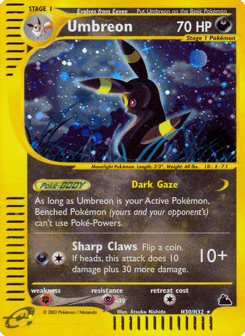
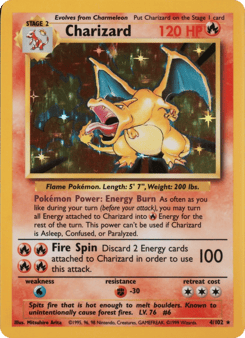
Here are three cards 26 years apart. Charizard (Base Set) came out in 1999, Umbreon VMAX (Evolving Skies) from Evolving Skies in 2021 (about $2,200 raw today), and Umbreon ex (Prismatic Evolutions) from Prismatic Evolutions in 2025 (about $1,528). All three fit the same sleeve, the same toploader and the same binder pocket.
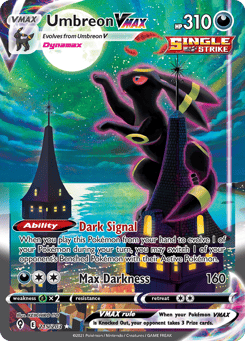
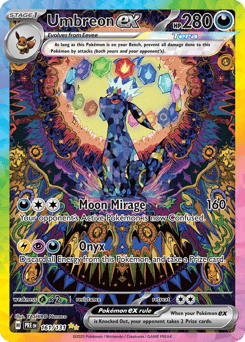
What does change is how the cards feel. Modern textured full arts and special illustration rares have an etched surface you can feel with a fingertip, and holo patterns differ from era to era. Neither affects size. If a pack-issued card measures noticeably different from your other cards, that's a warning sign, covered further down.
Jumbo and oversized cards
The exception is jumbo cards: oversized promos that come in some special products. They're made for display rather than play.
There isn't one jumbo size. They've been made in different dimensions over the years, so measure yours before buying a holder. Standard sleeves and toploaders won't fit, and neither will Ultra Pro's oversized sleeves if your card is larger than the 3.5 × 5 inches they're made for. For display, a photo frame or a large rigid sleeve sized to your measurement works; many collectors simply keep jumbos in the box they came in.
Jumbo cards are mostly collected for display. Our prices cover standard-size English cards.
Sleeve and holder sizes that fit
Since the card size is standard, the accessories are too. These are the sizes you'll see on packaging, and what fits a Pokémon card.
| Accessory | Size to buy | What the maker says |
|---|---|---|
| Penny sleeve (soft, thin) | Standard, 2.5 × 3.5 in | Ultra Pro: holds 2-1/2 × 3-1/2 in (63.5 × 88.9 mm) cards up to 35pt thick |
| Deck or premium sleeve | Standard size | Dragon Shield: standard sleeves fit 63 × 88 mm cards, Pokémon included |
| Toploader | 3 × 4 in, 35pt | Ultra Pro: 3 × 4 in outside, holds standard cards up to 35pt |
| Magnetic holder | 35pt standard | Ultra Pro ONE-TOUCH: standard 2-1/2 × 3-1/2 in cards up to 35pt |
| Binder page | 9-, 12- or 16-pocket standard | Pockets sized for standard cards; check whether they fit sleeved cards |
| "Japanese size" sleeve | Not for Pokémon | Dragon Shield: 59 × 86 mm, for Yu-Gi-Oh!, Vanguard, Weiss Schwarz |
| Vintage toploader | Not needed | Ultra Pro: 2-5/8 × 3-3/4 in, for larger vintage-size cards |
A few things that trip people up:
- "3 × 4" is the toploader, not the card. Toploaders are sold by their outside size. The card inside is still 2.5 × 3.5.
- "pt" is thickness. One point is a thousandth of an inch, so 35pt is 0.035 inches, a little under a millimeter. A single Pokémon card, even in a penny sleeve, fits a 35pt toploader. Thicker holders (Ultra Pro sells 3 × 4 toploaders from 55pt up to 360pt) are for thicker cards, not for a normal Pokémon card, which will slide around in one.
- "Japanese size" doesn't mean Japanese Pokémon cards. It's the smaller size used by Yu-Gi-Oh! and a few other games. A Pokémon card won't go in.
- Double sleeving means a tight "perfect fit" inner sleeve plus a standard outer sleeve. It's common for valuable cards and decks. If you plan to put double-sleeved cards in a binder, pick one whose maker says the pockets take them.
For which binders and holders to choose, see our guide to the best Pokémon card binders and storage. For shipping, how to sell Pokémon cards covers the sleeve, toploader and cardboard method.
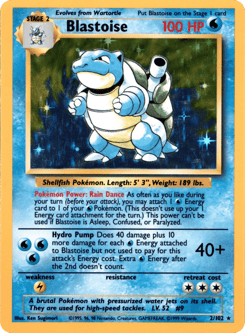
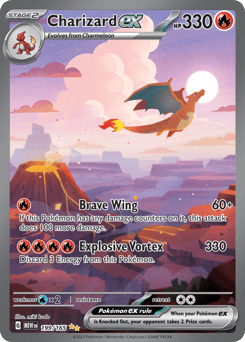
Vintage cards like Blastoise (Base Set) (about $158 raw) and Lugia (Neo Genesis) from Neo Genesis (about $598) are exactly the cards that should live in a penny sleeve and a 35pt toploader, and the same holder fits a modern card like Charizard ex (151) from 151.
Card size in pixels, for printing and scanning
If you're scanning cards, making a proxy for play-testing, or designing a custom card, the pixel size depends on resolution. At 2.5 × 3.5 inches:
| Resolution | Pixel size |
|---|---|
| 300 dpi (standard print quality) | 750 × 1050 px |
| 600 dpi (high-quality scan) | 1500 × 2100 px |
| 1200 dpi (detailed scan) | 3000 × 4200 px |
Print shops usually ask for a bleed, a margin of artwork past the cut line, so check their template before you design. And a note for anyone tempted: a printed copy of a real card is a proxy at best and a counterfeit at worst. Don't sell or trade one as the real thing.
Why size matters for spotting fakes and trimmed cards
Size won't prove a card is real, but it can flag one that isn't, or one that's been altered.
Counterfeits. Fake cards are often close to the right size but not exact, and they tend to differ in more obvious ways too: the wrong thickness or stiffness, a glossy or waxy feel, blurry printing, off colors, or a back that doesn't match. Lay a suspect card on top of a genuine card from the same era and line up the edges. If the corners or edges don't match, look harder at everything else. Our guide on how to tell if Pokémon cards are fake goes through the other checks.
Trimmed cards. Some people trim a card's edges to make worn borders look sharp or to fix off-center printing. A trimmed card will measure small on at least one side, and edges may look unusually clean or slightly uneven against a genuine card. PSA won't give a number grade to a card it judges to be trimmed or otherwise altered. If you're buying an expensive raw card, measuring it against a known genuine card from the same set is a sensible habit. It's one of the checks worth doing before sending a card off; how Pokémon card grading works covers the rest.
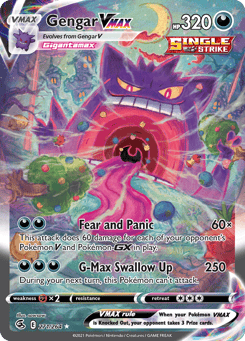
The cards most worth checking are the ones most worth faking: high-value modern alternate arts like Gengar VMAX (Fusion Strike) from Fusion Strike (about $1,053) and vintage Charizard holos. If a card at that level feels different in the hand from the rest of your collection, don't buy it, grade it or sell it until you know why.