What a graded card is
A graded card, or "slab", is an ordinary card sealed inside a hard, clear plastic holder. A label at the top names the card (year, set, card name and number, plus variants like 1st Edition or reverse holo), shows the grade, and carries a certification number and barcode.
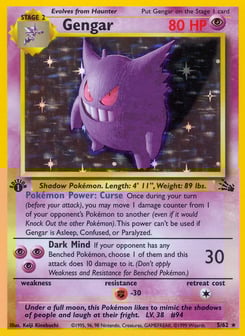
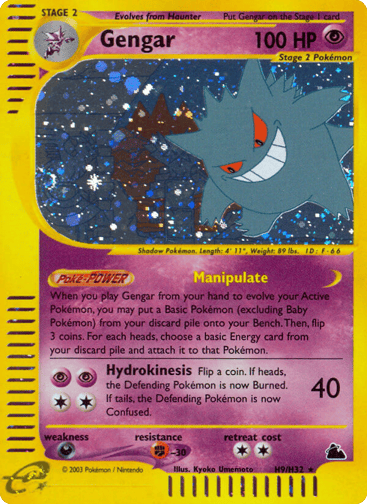
An ungraded card is called "raw". Every price on Ultraball has a raw price for a near-mint copy and, where there are enough sales, separate prices for each PSA grade. The gap between those numbers is the whole reason grading exists. A Gengar (Skyridge) from Skyridge sells for about $4,440 raw, about $13,267 as a PSA 9 and about $160,000 as a PSA 10. Same card, same printing; the grade is the difference. Skyridge was one of the last Wizards of the Coast sets, and you'll see the same raw-to-graded gap on our Gengar page and across the most valuable Skyridge cards.
Why collectors grade Pokémon cards
There are four honest reasons, and most submissions involve at least two.
- To prove condition. "Near mint" means different things to different sellers. A PSA 9 means the same thing to everyone.
- To prove it's real. Authentication comes first at every major grader. For expensive vintage cards, where fakes and altered cards circulate, that alone can be worth the fee. Our guide to spotting fake Pokémon cards explains what you can check yourself.
- To sell for more. A card in a high grade sells for more than a raw copy, sometimes many times more. Whether that covers the cost depends on the card; is it worth grading Pokémon cards runs the numbers.
- To protect and display it. The slab is sealed and rigid. For cards you love, that's reason enough.
Vintage holos tick most of those boxes at once. Lugia (Neo Genesis) and Blaine's Charizard (Gym Challenge) are both cards where buyers want proof of authenticity and condition before paying four figures, and both sell for far more in high grades than raw: about $2,999 and $1,400 respectively as a PSA 9.
What happens to your card inside the grading company
PSA has published a detailed walkthrough of an order's journey, and it's the clearest picture available of how a big grader handles cards. Other companies differ in the details, but the shape is similar.
- Arrival. Your package is scanned in, and you get an email. PSA receives a very large volume of packages every day, so the next step can take a while.
- Order entry. Staff open the box, check the cards against your submission form, and give the order a number. Each card gets a sticker with a unique certification number that follows it from here on.
- Research. A research team identifies each card precisely, so the label will be right: set, number, variant. You get an email to review the descriptions and can report an error.
- Anonymity. Before the cards leave research, the submission form is sealed in an envelope. From then on the cards are identified only by stickers, so the graders don't know whose cards they're grading.
- Grading. Graders authenticate each card and assess its condition on the 10-point scale.
- Labeling and sealing. A label with the card's description, grade, certification number and barcode is printed, and card and label are sonically sealed into the holder.
- Grade check. Another grader reviews the grade. PSA says every card it grades is evaluated by at least two graders, and any change sends the card back for a new label.
- Quality control. The holder and label are inspected for defects, and PSA reviews declared values. If a card turns out to be worth more than the service level you paid for, you're billed the difference.
- Results and return. Grades appear in your account before the order ships, and the slabs are sent back.
If you're about to send cards yourself, the practical side (forms, declared value, packing and shipping) is in how to get a Pokémon card graded.
What graders assess
Every major grader looks at the same four things.
Centering. How evenly the image sits within the borders, front and back. It's expressed as a split, like 60/40, measured left to right and top to bottom. PSA's limit for a 10 is about 55/45 on the front and 75/25 on the back. Centering is a factory problem, not a handling one, so plenty of pack-fresh modern cards are capped at 9 before anyone has touched them.
Corners. Sharpness at all four corners. Whitening on the blue Pokémon back shows up early, which is why vintage cards that were shuffled and played with rarely reach the top grades.
Edges. Chips, nicks and whitening along the sides, usually worst on the back.
Surface. Scratches, print lines, dents, stains, fingerprints and lost gloss. Holo foil and the textured surfaces on modern illustration rares are unforgiving here.
Beyond those four, PSA says graders weigh eye appeal, and it describes this as a small part of the technical process: a card with great eye appeal and a hairline crease still grades like a creased card. Separately, graders check for alterations. Evidence of trimming, recoloring, restoration or cleaning means no numeric grade at all.
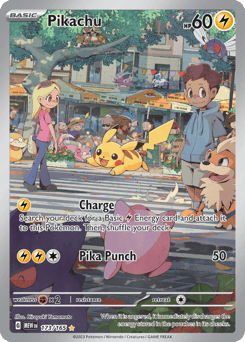
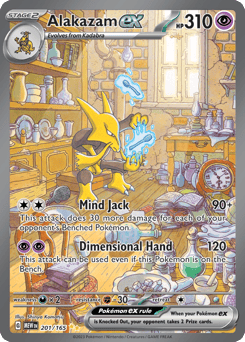
Take two popular modern cards from 151, an illustration rare Pikachu and a special illustration rare Alakazam. Pikachu (151) sells for about $90.12 raw, $99.00 as a PSA 9 and $580 as a PSA 10. Alakazam ex (151) sells for about $78.07 raw, $76.00 as a PSA 9 and $340 as a PSA 10. On both, a small centering miss or one surface scratch is the difference between the last two numbers.
How the grade is decided
The grade comes from the card's weakest area, measured against the grader's written standards. A card with perfect corners, edges and surface but 80/20 front centering can't be better than a PSA 6, because that's the most off-center a 6 allows. PSA does give some leeway: for grades of 7 and up, it allows about 5% extra on the front centering limit, and at the margins graders can make a judgment call based on eye appeal.
A few other things can appear on a label:
- Half points, like 8.5, for cards at the high end of a grade between 2 and 9. PSA says centering gets particular attention here.
- Qualifiers, letters such as OC (off center), ST (staining) or MK (marks, like writing), which flag one specific problem.
- Authentic, meaning the card is genuine but has no numeric grade.
Every grade from 10 down to 1, with PSA's centering limits and what each one sells for, is in the PSA grading scale explained.
The slab and the label
The holder protects the card and proves it hasn't been swapped. PSA seals its holders sonically, so opening one leaves obvious damage. The label is the part buyers read. On a PSA label you'll find:
- the year, set and card name, card number and any variant;
- the grade, written as both a number and an abbreviation (GEM MT 10, MINT 9, NM-MT 8 and so on);
- the certification number and a barcode.
Other graders do things differently. CGC's top grade, the Pristine 10, sits above its Gem Mint 10, and CGC uses half points across its scale. Beckett prints four subgrades (centering, corners, edges, surface) alongside the overall grade, and a card with 10 in all four gets its Black Label. TAG adds a score out of 1,000 and a digital defect report.
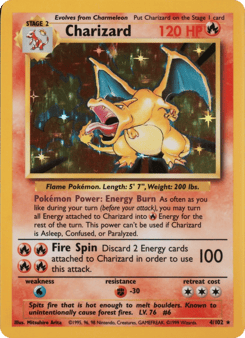
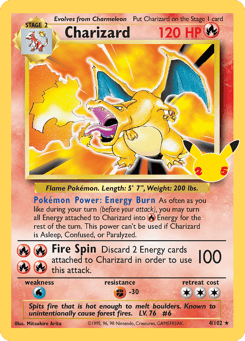
A tip for buyers: the label names the printing, which settles arguments on cards where a small detail changes the price. A PSA label on a Base Set Charizard (Base Set) says 1st Edition or Shadowless when the card is one, which is far more reliable than squinting at a listing photo. The Celebrations: Classic Collection reprint, Charizard (Celebrations: Classic Collection), is labeled as the 2021 card it is. For telling the Base Set printings apart raw, see 1st Edition vs Shadowless vs Unlimited.
After grading: verifying, the population report, selling
Once a card is graded, three tools matter.
- Certification lookup. Enter the certification number on the grader's website and you'll see the card's details and grade. PSA includes front and back images of the graded card at every service level, so you can compare the slab in front of you with the one PSA recorded. Always do this before buying a high-value slab.
- Population report. PSA publishes how many copies of each card it has graded at each grade. A card with very few 10s tends to sell at a premium, and a card with thousands of 10s usually doesn't.
- Selling. Graded cards have their own sold-price history by grade, which makes them easy to price. PSA also lets you store slabs in its vault or list them for sale straight from your account. Our how to sell Pokémon cards guide covers the options.
Grades aren't permanent in practice. Collectors sometimes crack a slab and resubmit a card they think was under-graded, or send a card graded by one company to another. Both cost another fee and carry the risk of a lower grade, so it's only worth it on cards where one grade step is worth a lot.
Which grading company?
For Pokémon, PSA is the reference point most buyers price against. In our sold data, a PSA 10 sold for more than a CGC 10 of the same card on about 97% of the cards where we have enough sales of both. CGC is cheaper and currently quicker, which makes it a strong choice for cards you're keeping. Beckett's subgrades appeal to modern collectors chasing the Black Label, and TAG's detailed reports have their own following.
As of September 2026, PSA's cheapest open service is Standard at $59.99 a card for cards worth up to $1,000, and CGC's cheapest is its $17 Bulk tier (25-card minimum, cards up to $500). Every tier and turnaround is in PSA grading cost.
Why PSA 9s are often cheap
People are often surprised that a PSA 9 of a modern card can sell for about the same as a raw copy, or less. It comes down to two things. First, PSA says about 90% of modern trading card game cards it has graded since 2018 came back at 8 or higher, so a 9 isn't rare. Second, buyers of raw modern cards are often buying a lottery ticket on a 10. Once a card is sealed as a 9, that ticket has been scratched.
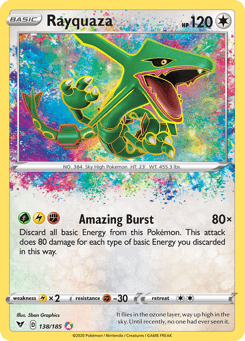
Rayquaza (Vivid Voltage), an amazing rare from Vivid Voltage, sells for about $28.93 raw, $44.49 as a PSA 9 and $188 as a PSA 10. That's the typical modern shape: 9 close to raw, 10 far above both.
Vintage is different, because clean survivors are scarce. The Dragonite holo Dragonite (Fossil) from Fossil sells for about $132 raw, $660 as a PSA 9 and $6,500 as a PSA 10. Here a 9 is a genuinely good result. Across the cards we price, a PSA 10 typically sells for roughly three to five times a PSA 9, in both old and new sets; the difference is where the 9 sits relative to raw.