Step 1: Decide which cards are worth it
Before you touch a submission form, price every card three ways: raw, as a PSA 9 and as a PSA 10. Search each card on Ultraball (our price checker guide shows how to find the exact printing) and write the numbers down.
Then be honest about the grade. If only a PSA 10 makes the maths work and the card isn't flawless, leave it out. Most modern cards need a 10 to justify the fee, while clean vintage holos often pay at an 8 or 9. We go through this card by card in is it worth grading Pokémon cards, and the fee side is in PSA grading cost.
Two cards from recent sets show the difference. Mega Froslass ex (Ascended Heroes) sells for about $9.49 raw and $67.00 as a PSA 10, so even a perfect grade barely covers the fee. Charmander (151) sells for about $97.07 raw and $649 as a PSA 10, which is the kind of gap that justifies a submission, if the copy is clean.


A good first submission is a handful of cards you're confident in, not a stack of maybes. You'll learn how the grader sees your cards, and the next order will be sharper.
Step 2: Inspect each card like a grader
Graders look at four things: centering, corners, edges and surface. Do the same, in good light, ideally with a magnifier.
- Centering. Compare the border widths left to right and top to bottom, front and back. PSA's standard for a Gem Mint 10 is roughly 55/45 or better on the front and 75/25 on the back. If one border is clearly fatter than the other, a 10 is off the table.
- Corners. Look for whitening, fraying or softness at all eight corners (four on each side). Blue-backed cards show every nick.
- Edges. Run your eye along each edge on the back for chipping or white specks.
- Surface. Tilt the card under a lamp. Scratches, print lines, dents and fingerprints on holo foil show up at an angle.
Old holos are the hardest test. The foil on a Base Set Charizard (Base Set) scratches if you look at it wrong, and the blue back of a Blaine's Charizard (Gym Challenge) shows edge wear like a white chalk line. Check both sides of cards like these under the brightest light you own.
If a card might be fake, or might have been trimmed, find out before you pay. PSA won't give a number to cards with evidence of trimming, restoration or recoloring, and it charges the fee anyway. Our guide to spotting fake Pokémon cards covers the checks.
Don't "clean" cards with anything but a dry microfiber cloth. PSA's grading standards list evidence of cleaning, and foreign substances such as cleaning sprays or wax on the surface, as reasons to return a card with no numeric grade. A gentle wipe to lift a fingerprint is fine. Liquids and polishes are not.
For what each grade actually allows, from 10 down to 1, read the PSA grading scale explained.
Step 3: Choose a grading company
Four companies grade most English Pokémon cards.
- PSA. The default for resale. In our sold data, a PSA 10 sold for more than a CGC 10 of the same card on about 97% of cards where we have enough sales of both. If you plan to sell, PSA is usually the label buyers pay most for.
- CGC. Cheaper and, as of September 2026, faster at every comparable tier. Its top grade is the Pristine 10, above its standard Gem Mint 10. A good choice for cards you're keeping, or cards where the fee matters more than the label.
- Beckett (BGS). Gives four subgrades (centering, corners, edges, surface) on top of the overall grade. A card with 10 on all four gets the Black Label, which sells at a premium on modern cards.
- TAG. Adds a 1,000-point score and a digital report showing each defect. Its regular tiers were paused when we checked in September 2026.
Our honest take: for a card you might sell, check the PSA 10 and CGC 10 prices on the card's page and pick the grader whose premium beats its extra cost. For a binder of personal favorites, CGC's bulk tier is hard to argue with.


Big modern cards like the Prismatic Evolutions Umbreon ex (Prismatic Evolutions) (about $1,528 raw, $5,575 as a PSA 10) and the Evolving Skies Umbreon VMAX (Evolving Skies) (about $2,200 raw, $4,050 as a PSA 10) are where the grader choice matters most, because the gap between labels on a four-figure card is real money. Our Umbreon page lists every version with its graded prices. The how Pokémon card grading works guide compares the companies' scales and labels in more detail.
Step 4: Choose a service level (declared value)
This is the step that trips people up. You don't pick a service level by what the card is worth now. You pick it by what the card will be worth after grading, which PSA calls the declared value. That number sets both the tier and the maximum insurance cover.
PSA's own advice is to look up recent sold prices for your card at the grade you expect, over the last three to six months, and use that. On Ultraball, that's the PSA 9 or PSA 10 price on the card's page.
As of September 2026, the main PSA levels for Pokémon cards are:
| PSA level | Price per card | Max declared value | Estimated turnaround |
|---|---|---|---|
| Standard | $59.99 | $1,000 | 90–100 business days |
| Priority | $79.99 | $1,500 | 70–80 business days |
| Express | $199 | $2,500 | 20–30 business days |
| Super Express | $349 | $5,000 | 10–15 business days |
| Premier | $599 | $10,000 | 7–10 business days |
Premium levels go higher for cards worth more than $10,000. PSA's cheaper Value tiers have been paused since June 2, 2026.
Three examples using today's PSA 10 prices:
- Charizard (Celebrations: Classic Collection) sells for about $505 as a PSA 10. If that's under $1,000, Standard covers it even if it comes back perfect.
- Charizard ex (151) from 151 sells for about $1,425 as a PSA 10. If you think yours could be a 10, declare that and pick the level whose cap sits above it.
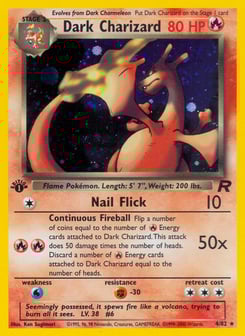
- Dark Charizard (Team Rocket) from Team Rocket sells for about $875 as a PSA 9 and $10,800 as a PSA 10. Declare the 9 price if a 9 is realistic; if it surprises you with a 10, PSA moves it to the right tier and bills you the difference.


That last point is the upcharge rule. If PSA grades a card and it's worth more than your level's cap, it bumps that card (not the whole order) to the level that fits and charges the difference. Under-declaring doesn't save money on a card that grades well; it just delays the bill.
Step 5: Build the submission
Create an account on psacard.com, then build the order online or in the PSA app. For each card you'll enter:
- the year, set, card name, card number and any variant (1st Edition, Shadowless, reverse holo);
- the declared value;
- the service level.
You don't have to be perfect on the description. PSA's research team identifies each card when it arrives and emails you once they're done, so you can flag anything that looks wrong before labels are printed. It still pays to be accurate, especially on printings: if you have a Shadowless Venusaur (Base Set) rather than an Unlimited Venusaur (Base Set), say so. Our guide to 1st Edition vs Shadowless vs Unlimited helps you get that right, and the 1st Edition guide covers the stamp on later sets.

Pay, then print two things from the confirmation page: the submission form, which goes in the box, and the tracking label, which goes on the outside.
Step 6: Pack the cards the way PSA asks
PSA publishes a ten-step shipping guide, and following it to the letter is the easiest way to avoid delays. In short:
- Gather supplies: clear penny sleeves, semi-rigid card holders, two pieces of cardboard, rubber bands, a new box, bubble wrap and packing tape.
- Sleeve each card in a clear penny sleeve. No colored or opaque sleeves.
- Put each sleeved card in a semi-rigid holder. PSA specifies 3 5/16" x 4 7/8" for standard cards. No toploaders, no tape, no pull tabs, no sticky notes.
- Stack them in the order on your submission form, item 1 on top. PSA's own walkthrough says orders that arrive out of sequence are pulled for special handling, which costs you time.
- Sandwich the stack between two pieces of cardboard and hold it with two or three rubber bands, snug but not tight.
- Wrap it and box it in a new box, filling the empty space so nothing moves.
- Put the printed submission form inside.
- Seal every seam with packing tape. Not painter's tape, not clear office tape, not reused tape.
- Stick the tracking label from your confirmation page on the outside, barcode fully visible.
- Address it to the right PSA location for your carrier. PSA lists one address for USPS and another for UPS, FedEx and DHL.
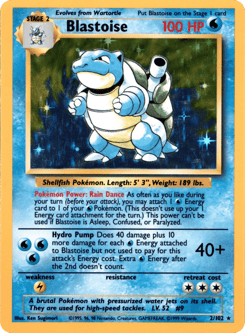
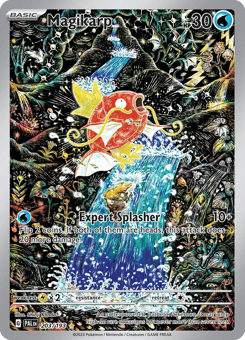
Semi-rigid holders, not toploaders, are the rule first-timers break most often, and PSA is explicit about it. It doesn't matter whether you're sending a vintage Blastoise (Base Set), a Fossil Dragonite (Fossil) or a modern Magikarp (Paldea Evolved): they all go in the same kind of holder.
Step 7: Ship and insure
PSA does not insure your cards while they're on the way to it. Its cover starts once the order has been received, unpacked and identified. So:
- use a tracked service;
- buy carrier insurance for the full value if the cards are worth it;
- keep your receipt and photos of the cards and the packed box.
Step 8: What happens while you wait
PSA has published a walkthrough of an order's journey, and it's reassuring reading. Roughly:
- Arrival. Your box is scanned in and you get an email. The order number comes later, when the receiving team enters it.
- Research. Each card is identified for its label. You get an email to review the descriptions.
- Anonymity. Your submission form is sealed in an envelope before grading. From then on the cards are tracked by sticker only, so graders don't know whose cards they're holding.
- Grading. Graders assess centering, corners, edges and surface, plus eye appeal.
- Labeling and sealing. Labels with the description, grade, certification number and barcode are printed, and each card is sonically sealed in a tamper-evident holder.
- Grade check and QA. A second grader reviews each grade. PSA says every card is seen by at least two graders. The holder and label are checked, and declared values are reviewed for upcharges.
Turnaround estimates are counted in business days from when PSA receives and scans your order, not from when you ship, and PSA says they aren't guaranteed. Standard's 90–100 business days is roughly four to five months.
Step 9: Grades, upcharges and the return
When grading is done, your grades appear in your PSA account (and in the app) before the box ships. Pay any upcharges you're notified about, then choose what happens to each card: ship it home, store it in PSA's vault, or list it for sale.
When the slabs arrive, check each one: the label description, the grade, and the certification number, which you can look up on psacard.com. Every service level includes front and back images of the graded card on its certification page, which is handy if you're selling later.
Then compare your results with current sold prices for each grade before you list anything, because the grade you got is rarely the one you priced in. Our PSA 10 Pokémon cards guide shows how steep the gap between a 9 and a 10 can be, and how to sell Pokémon cards covers listing slabs.
Cost and timing at a glance
| What | Typical cost or time (as of September 2026) |
|---|---|
| PSA grading fee | from $59.99 per card (Standard, up to $1,000) |
| CGC grading fee | from $17 per card (Bulk, 25-card minimum, up to $500) or $20 (Economy, up to $1,000) |
| Shipping to the grader | your carrier's rate plus insurance you buy |
| Return shipping | charged by the grader on top of the fee |
| Upcharge | the difference to the right tier, if a card grades above your declared level |
| PSA Standard turnaround | 90–100 business days from receipt |
The full price list for every PSA level, and CGC's faster tiers, is in PSA grading cost.
Other ways to submit
You don't have to mail cards yourself. PSA says you can also hand-deliver at its local submission events, which avoids inbound shipping risk, and it lists authorized dealers on its website. Many card shops run group submissions, where the shop packs and ships many customers' cards in one order. That can save shipping cost; the trade-off is that your cards wait for the group to fill and pass through another pair of hands. Ask the shop how it handles declared values, upcharges and insurance before handing anything over.