What counts as an error card
Collectors split errors into two groups, and the difference decides almost everything about value.
- Corrected errors. A mistake in the card's design, like a missing word or a wrong symbol, that was spotted and fixed during printing. Only the copies printed before the fix have the error, so it's a limited version of the card. Repeating ink flaws that appear in the same place on a run of cards belong here too.
- Uncorrected errors. A mistake that was never fixed, so every copy has it. These are interesting trivia, but since every copy is the same, they aren't scarce. Bulbapedia's error card list splits every set this way and describes uncorrected errors as "not rare or desirable to collectors".
Then there are one-off production faults: miscuts, crimps from the pack seal, blank cards, cards with a back printed upside down. Each copy is unique. Dramatic ones can sell well to error collectors, but they're priced one at a time and the market is small.
The easiest way to know whether your error has a market is to check whether a grading company recognizes it. PSA keeps a Pokémon error guide of the variations it will name on the label. If an error isn't on that list and isn't widely documented elsewhere, assume it's worth about what the normal card is.
Why some errors are worth more
The same three things drive error prices as drive any card's price: scarcity, demand and condition.
Scarcity comes from the correction. When an error was fixed early, the error version is scarce. When it was fixed late, the corrected version is the scarce one, and that catches people out. Blaine's Charizard (Gym Challenge) is the classic case: 1st Edition and early Unlimited copies print a Fighting Energy symbol in the Roaring Flames attack instead of Fire, and Unlimited copies were only corrected very late in the print run. So on that card, the "fixed" version is the one collectors hunt. A normal copy sells for about $582.
Demand comes from the card. An error on a Base Set Blastoise has thousands of potential buyers. The same error on a Base Set Diglett has a few dozen. And condition still matters: a clean graded error beats a battered one by the same kind of margin as any other card, which is why the errors people talk about are nearly always slabbed.
Famous English error cards
These are the errors that are documented by PSA's guide, Bulbapedia's list, or both. Prices on Ultraball are for the normal version of each card; we don't price error variants separately, so treat the linked page as the baseline and expect a recognized error to sell above it.
Base Set
Base Set has more well-known errors than any other English set, partly because it was printed so many times.
- Blastoise "Stage" error. Some Unlimited copies of Blastoise (Base Set) are missing the word "Stage" in the top right corner.
- Blastoise "Illus." error. Other Unlimited copies are missing, or nearly missing, "Illus." before the artist's name at the bottom left. Bulbapedia calls it much rarer than the Stage error.
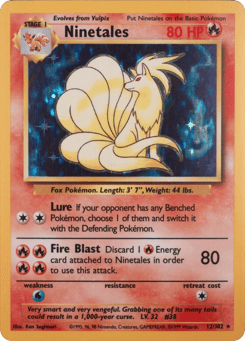
- Ninetales "no damage". Some Shadowless copies of Ninetales (Base Set) are missing the 80 damage for Fire Blast. Bulbapedia traces them to the Brushfire theme deck.
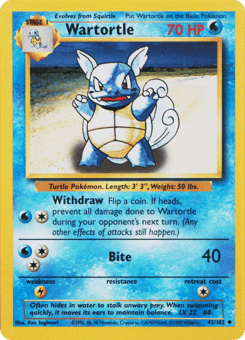
- Wartortle evolution box. A short Unlimited run of Wartortle (Base Set) shows Wartortle instead of Squirtle in the little evolution box at the top left.
- Beedrill "D.efending". Some Unlimited copies of Beedrill (Base Set) have a stray period in "D.efending" in the Poison Sting text.
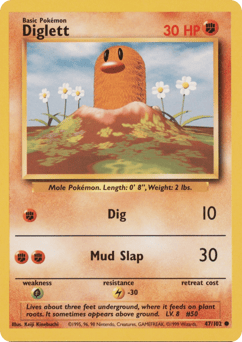
- Diglett sideways symbol. Diglett (Base Set) with the Fighting Energy symbol in its Dig attack rotated 90 degrees, from Unlimited 2-Player Starter Set boxes.
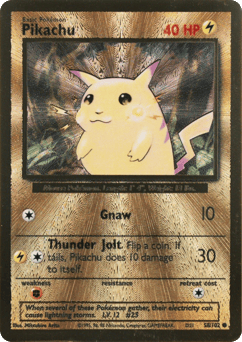
- Ghost stamp Pikachu. A Shadowless Pikachu (Base Set) with only a faint outline of a 1st Edition stamp, found in Shadowless Zap! theme decks.
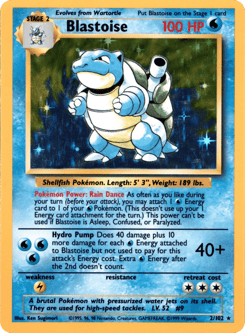
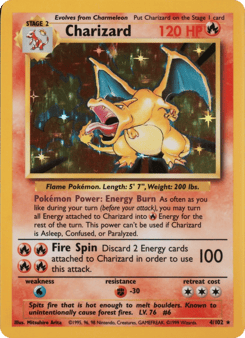
Base Set also has the best known dot errors, where a speck of ink shows up in the same spot on many copies. PSA names black dots on Charizard (Base Set), Chansey (Base Set) and Clefairy (Base Set), blue dots on 1st Edition and Shadowless Vulpix (Base Set), and red dots on Unlimited Blastoise, plus the "red heart" on Clefairy. PSA only recognizes a dot error when it turns up in the same place and shape across multiple documented copies, so a random speck on your card doesn't count. If your Base Set card has one of these, compare it closely against photos of a slabbed example before you get excited. Our Shadowless guide and 1st Edition guide cover the printings these errors sit on.
Jungle and Fossil
- Jungle "no symbol" holos. A print run of Unlimited Jungle had all 16 holos missing the flower set symbol under the art box. Bulbapedia describes it as a large print run, so these turn up more often than most vintage errors.
- Butterfree "d" edition. On 1st Edition Butterfree (Jungle), a small ink ring in the stamp makes the "1" look like a "d". Bulbapedia calls it one of the most common Wizards-era errors, with well over 100 copies known.
- Pinsir 1st Edition scratch. 1st Edition holo Pinsir with holo-like scratches running through the stamp.
- Venonat line. A long black ink line down the top left of the yellow border on 1st Edition Venonat (Jungle).
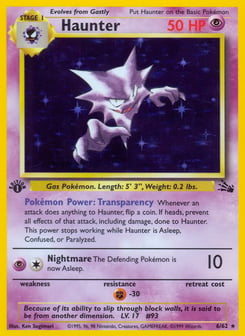
- Fossil stains. 1st Edition holo Hitmonlee with gold ink stains down the left side, and Unlimited holo Haunter with a blue ink stain near its hand.
- Krabby slash. Some Unlimited copies of Krabby (Fossil) have an incomplete set symbol, known as "Fossil Slash Krabby".
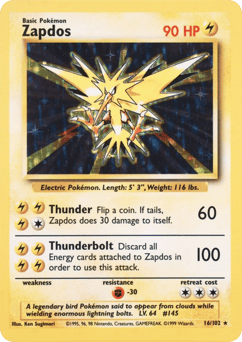
- Zapdos missing foil. Holo Zapdos from Fossil left an empty space for an evolution box even though Zapdos is a Basic, so the foil is missing in that corner on all 1st Edition and most Unlimited copies. A later Unlimited run filled it in. PSA recognizes both versions, but Bulbapedia notes that both were mass-produced and neither is rare, so this one is more about completeness than price.
- Slowpoke artist credit. 1st Edition and Unlimited Slowpoke (Fossil) credit the illustrator as "Miki Takano" instead of Miki Tanaka. It was fixed on the third print, the one with a 1999-2000 copyright.
Team Rocket to Neo
- Dark Dragonite without holo. A non-holo Dark Dragonite #5 from Team Rocket was put on the uncommon sheet by mistake, using the holo card's template rather than the non-holo #22. It was never corrected, so it's a well-known oddity rather than a scarce one. A normal holo copy sells for about $185.
- Blaine's Charizard energy symbol. Covered above. Gym Challenge is the set.
- Neo Revelation double holo. Some holos in Neo Revelation have foil spreading outside the areas it should cover. PSA's example is Ho-oh (Neo Revelation), with foil running into the wings.
Later sets
Errors get rarer and less valuable after the Wizards era, but a few are recognized:
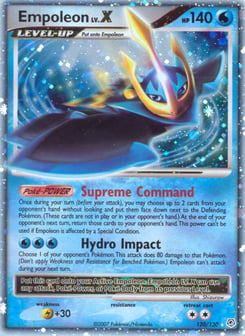
- Empoleon LV.X Poké-BODY. Early prints of Empoleon LV.X (Diamond & Pearl) label its Poké-POWER as a Poké-BODY. The tin promo version was fixed.
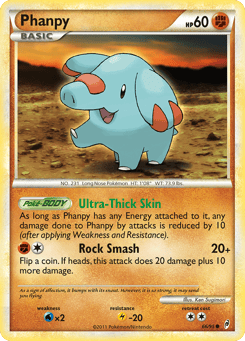
- "Phanphy". Early prints of Phanpy (Call of Legends) from Call of Legends spell it "Phanphy" twice in the Poké-Body text.
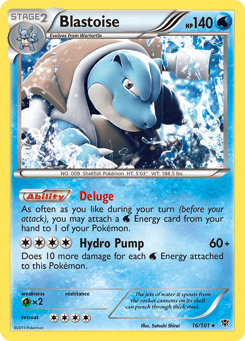
- Blastoise "©2012". The Blastoise (Plasma Blast) from Plasma Blast reprinted in XY two-pack blisters lists a ©2012 copyright, even though the set came out in 2013.
Promos
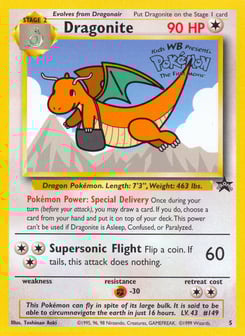
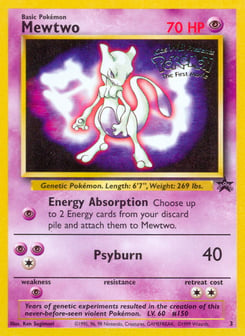
- First Movie promos, inverted stamp. The four Pokémon: The First Movie promos, Electabuzz, Mewtwo, Pikachu and Dragonite, can be found with the movie stamp printed upside down in the bottom left corner.
- Movie 2000 promos, wrong artist. Moltres, Articuno and Zapdos from the second movie credit Toshinao Aoki instead of Naoyo Kimura on the first print runs. Later prints fixed it.
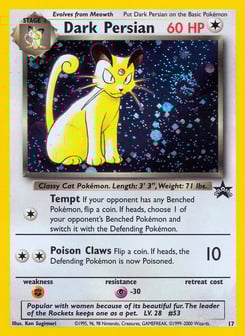
- Dark Persian, no HP. The Nintendo Power promo Dark Persian (Wizards Black Star Promos) exists with its 60 HP missing entirely. A normal copy sells for about $132.
The Wizards Black Star Promos page lists all of these.
Errors that aren't errors
A few cards get sold as errors when they aren't:
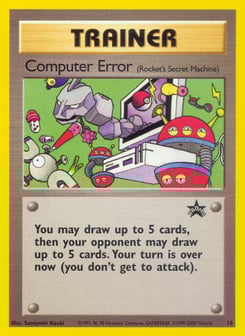
- Computer Error. It's a real Trainer card from 2000, not a misprint. The name is the joke. A normal copy sells for about $7.93, and that's what it's worth.
- Red cheeks Pikachu. 1st Edition and Shadowless Base Set Pikachu have red cheeks; later prints have yellow. Bulbapedia's account is that Mitsuhiro Arita drew them yellow, Wizards changed them to red without his permission, and they were later switched back, so it was a deliberate design change, not a printing fault. Collectors still notice it because red cheeks only appear on the 1st Edition, Shadowless and E3 promo prints.
- Shadowless cards. Not an error. It's an early print run of Base Set, and our Shadowless guide explains what to look for. The same goes for the side-by-side in 1st Edition vs Shadowless vs Unlimited.
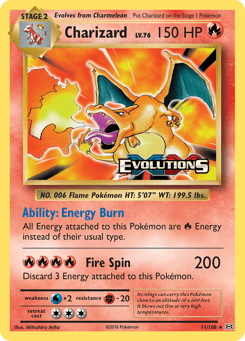
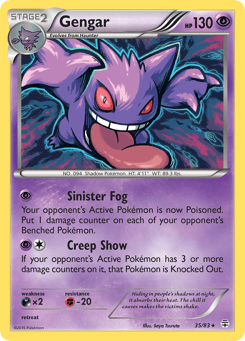
- Holo bleed on Evolutions and Generations. Plenty of holos in Evolutions and Generations have the holo pattern bleeding across the entire card. Bulbapedia lists it on many holos in both sets, including Generations Gengar, so it isn't scarce and adds little. Evolutions Charizard is also found with greenish patches where it should be yellow, on more than one copy.
Common kinds of misprints, and what they're worth
| Error type | What it looks like | Usually worth a premium? |
|---|---|---|
| Design error, corrected | Wrong symbol, missing word, typo, fixed later | Yes, if on a popular card |
| Design error, never corrected | Same mistake on every copy | No |
| Repeating ink dot or stain | Same mark, same spot, many copies | Sometimes; must be documented |
| Random ink speck | One-off mark | No |
| Missing holo or texture | No foil at all, or a full art with no texture | Sometimes; PSA only names texture errors if it's missing from the whole card |
| Incomplete holo | Foil stops partway across the art | Occasionally |
| Holo bleed or shift | Foil spills or sits off-position | Rarely, unless dramatic |
| Miscut | Card cut off-center, sometimes showing part of the next card | Only dramatic ones, to error collectors |
| Crimp | Pack seal pressed into the card | Small premium on vintage; Bulbapedia notes Unlimited Machamp is the most common crimp |
| Inverted back | Back printed upside down relative to the front | Sometimes |
PSA's guide notes that "Missing Foil Error" goes on the label when the holo is completely missing, and that texture errors only count if the whole card is smooth. Partial cases are just condition.
Modern error cards
Modern printing is tighter, and modern sets are printed in huge numbers, so errors are both less common per card and less scarce when they happen. Full arts with the texture missing and holos with the foil stopping partway, like PSA's example from Next Destinies, are the ones that get attention. Unless the error sits on a chase card, don't expect much. If you pull a textureless full art of a card that already sells well, that's worth grading. A slightly miscut common isn't.
How to check an error card
Before you list or grade a card as an error:
- Find it in a reference. PSA's error guide and Bulbapedia's error card list cover most documented English errors. If it's on neither, be skeptical.
- Compare with a graded example. Look up slabbed copies with the error named on the label and compare the exact position and shape of the mark.
- Check it isn't damage. Trimmed edges can pass for a miscut, and scratched or rubbed foil can pass for a missing holo. PSA's grading standards give no grade to trimmed or altered cards, so an "error" made by hand will come back as altered.
- Rule out a fake. Counterfeits are often mistaken for errors because the font, color or foil looks off. Our guide on how to tell if Pokémon cards are fake covers what to check.
If it passes those checks and sits on a card with real demand, grading with PSA gets the error named on the label, which is what error buyers pay for. The how to get a Pokémon card graded guide walks through the submission, and is it worth grading your Pokémon cards helps you decide whether the fee makes sense.
Pricing an error card
Error variants trade rarely, so there's no daily market price the way there is for normal cards. Start from the normal card: search it on Ultraball and note the raw and graded prices, which come from recorded sold listings (our pricing notes explain how). Then look for sold examples of the named error in the same grade. A recognized error on a Wizards-era holo usually sells at a clear premium over that baseline. Most modern and one-off errors sell close to it.
If the card turns out to be a normal copy after all, it may still be worth something. Our guides on what makes a Pokémon card valuable and old Pokémon cards worth money will tell you where it stands.