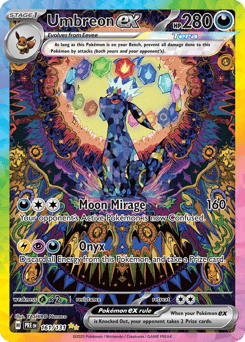
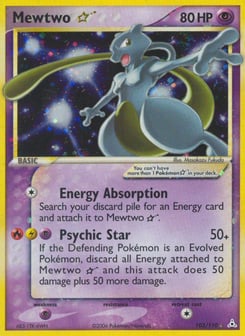
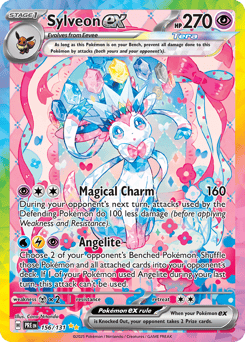
Step 1: Find the rarity symbol
Turn the card face up and look along the bottom edge. The rarity symbol sits right beside the collector number, which is printed as two numbers with a slash between them.
Where exactly depends on the era:
- Wizards of the Coast cards, 1999 to 2003. Bottom right corner, next to a number like 4/102. Base Set cards have no set symbol, so the rarity symbol is the only icon in that corner.
- EX era through Sword & Shield, 2003 to 2023. Still along the bottom edge, next to the card number. Which side it sits on changed a few times, so check both corners.
- Scarlet & Violet and Mega Evolution, 2023 onward. Bottom left, next to the set code, a small regulation letter in a white box, and the card number.
Three things near the symbol confuse people:
- The set symbol. A small icon that tells you which expansion the card is from. On modern cards it has been replaced by a short set code. It has nothing to do with rarity.
- The regulation mark. That single letter in a white box on modern cards is for tournament legality.
- The 1st Edition stamp. A black circle with a "1" and "Edition", on the left side under the artwork on early Wizards cards. It marks a print run, not a rarity. More on that below.
On dark cards and full arts the symbol is printed in white or silver, and on some silver-bordered full arts it's so faint you have to tilt the card under a lamp to see it. A white star on a black card is the same rarity as a black star on a white card.
The rarity symbol table
Here's how to read the symbol. The names link to pages listing every English card at that rarity, most valuable first. For the full history of each tier, our Pokémon card rarity chart goes era by era.
| Symbol | Rarity | What the card looks like | Eras |
|---|---|---|---|
| ● Black circle | Common | Plain card, several per pack | All |
| ◆ Black diamond | Uncommon | Plain card, three or more per pack | All |
| ★ Black star | Rare (Holo Rare before 2023, if the art is foil) | Plain or holo art box | All |
| ★ Black star with "PROMO" | Promo | Not from booster packs | All |
| ★ White or silver star | Ultra Rare, EX, GX, V, LV.X and other special cards | Often full art or a rule-box Pokémon | Before 2023 |
| ★★ Two black stars | Double Rare | Holo Pokémon ex in a normal frame | 2023 onward |
| ★★ Two silver stars | Ultra Rare | Textured full art | 2023 onward |
| ★ One gold star | Illustration Rare | Full-bleed art of a regular Pokémon | 2023 onward |
| ★★ Two gold stars | Special Illustration Rare | Full-bleed art of an ex Pokémon or a Supporter | 2023 onward |
| ★★★ Three gold stars | Hyper Rare | All-gold card | 2023 to 2025 |
| Gold Mega symbol | Mega Hyper Rare | Gold, embossed Mega Pokémon | 2025 onward |
| One pink and one green star | Mega Attack Rare | Mega Pokémon with its attack name in kanji | 2026 onward |
| One pink star | ACE SPEC | Pink card design | 2024 to 2025 |
| Outline of one or two gold stars | Shiny Rare / Shiny Ultra Rare | Shiny-colored Pokémon | Paldean Fates only |
| Rainbow "A" | Amazing Rare | Special foil card in a few Sword & Shield sets | 2020 to 2021 |
The core tiers run from common at the top down to the gold-star cards. The rows below those are special rarities tied to particular sets. The newest, the Mega Hyper Rare, has pull odds as low as 1 in 1,260 packs according to CGC's rarity guide.
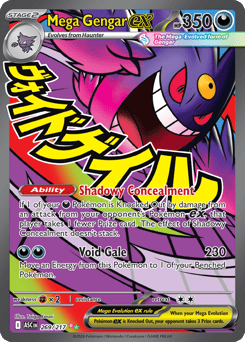
Mega Charizard Y ex (Ascended Heroes) is a Mega Hyper Rare, and Mega Gengar ex (Ascended Heroes) shows the Mega Attack Rare style, with the attack name written in kanji across the art.
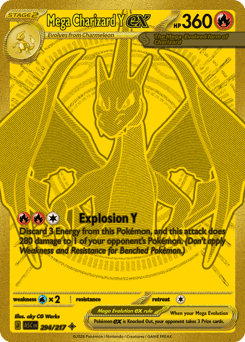
Before 2023, a single star covered almost everything from a plain rare to a gold secret rare, so on older cards the symbol alone tells you less. That's what the next three steps are for.
Step 2: Read the card number for secret rares
The collector number is the most reliable rarity check there is, and it works on every era.
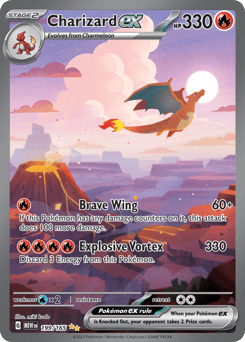
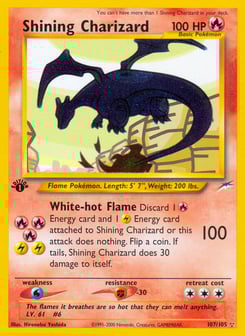
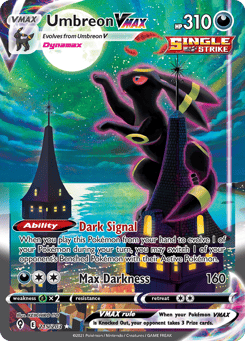
The second number is how many cards the set officially lists. If the first number is bigger, the card is a secret rare: printed beyond the set list and almost always rarer than anything numbered inside it. The Special Illustration Rare Charizard ex from 151 is numbered 199/165. Shining Charizard (Neo Destiny) is numbered 107/105, and the alternate-art Umbreon VMAX from Evolving Skies is 215/203. All three are secret rares, and the first two were printed more than twenty years apart.
Some sets use a letter prefix instead: "TG" for the Trainer Gallery subsets of 2022 and 2023, "GG" for the Crown Zenith Galarian Gallery, and "SV" for the Shiny Vaults in Hidden Fates and Shining Fates. Those subsets have their own numbering, so the Shiny Charizard-GX numbered SV49/SV94 is a chase card even though its number looks small. The same goes for Mew from the Galarian Gallery and Pikachu from the Lost Origin Trainer Gallery.
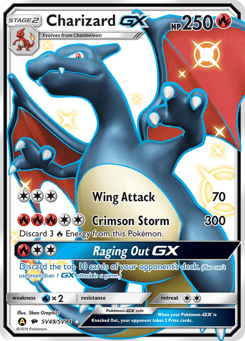
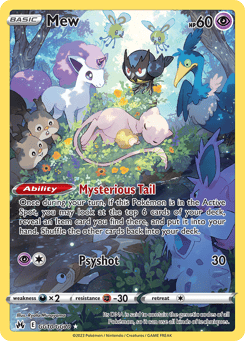
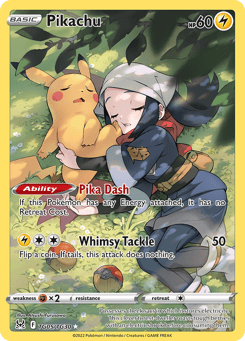
The secret rare page lists every English card in that category. Not all of them are expensive, but it's where most of the big modern prices sit.
Step 3: Look at the finish
Shine is the thing everyone notices first, and it's the least reliable sign of rarity on its own.
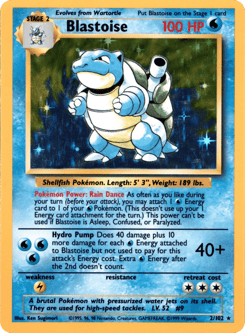
- Holo. Only the artwork box is foil. On Wizards and early modern cards, a holo means a Holo Rare, a real step up from a plain rare. Blastoise (Base Set) is the classic example.
- Reverse holo. Everything except the artwork box is foil. Reverse holos exist for commons, uncommons and rares in almost every set since 2002, so a reverse holo common is still a common. Our guide to reverse holo Pokémon cards covers the few that are worth money.
- Full art. The artwork covers the whole card, usually with a raised texture you can feel with a thumb. Full arts are Ultra Rare or higher.
- Gold. A gold border and gold background mean a gold secret rare or, from 2023 to 2025, a Hyper Rare. There's a full rundown in are gold Pokémon cards worth anything.
Since Scarlet & Violet, every Rare in a pack is holo, so a holo rare today is the baseline, not a lucky pull. On a 1999 card the same shine means a lot more.
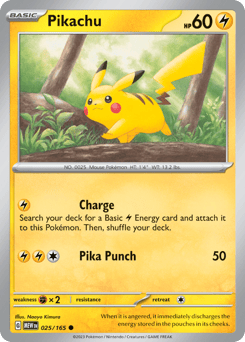
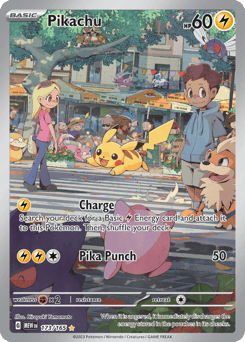
That row shows the point. The regular Pikachu from 151 is a common. The Illustration Rare Pikachu from the same set, numbered 173/165, sells for about $90.12. Same Pokémon, same set, and the only things that tell you which one you have are the gold star, the number and the full-bleed art.
Step 4: Check the name for a special rarity
For about twenty years, the rarest cards in a set were marked by what's in the card's name as much as by the symbol. If your card's name has one of these, it's a higher-rarity card from that era:
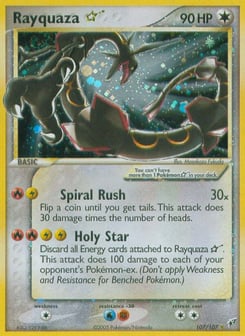
- ☆ after the name. A Gold Star card from the EX era, 2004 to 2007. These are some of the scarcest pack cards ever printed. Rayquaza ☆ (Deoxys) is the best known, and it's pictured below.
- "Shining" before the name. Shining cards from the Neo sets of 2001 and 2002, plus Shining Legends in 2017.
- LV.X. LV.X cards from Diamond & Pearl and Platinum, 2007 to 2009.
- ex (lowercase, 2003 to 2007), EX, GX, V, VMAX, VSTAR. The big "rule box" Pokémon of each era, usually Ultra Rare, with full-art and secret versions above them.
- ◇ after the name. A Prism Star card from Sun & Moon.
- "Radiant" before the name. A Radiant Rare from 2022 and 2023.
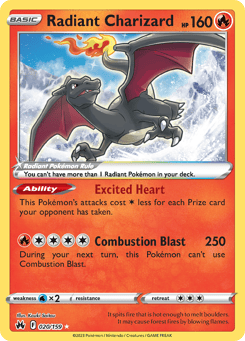
Radiant Charizard (Crown Zenith) is a typical Radiant: a special rarity from a chase-heavy set, and it still sells for only about $12.33.
The newest ex cards from 2023 onward use a lowercase "ex" again. On their own they're Double Rares. The same Pokémon may also appear in the set as a full-art Ultra Rare, an SIR and sometimes a gold Hyper Rare, and those versions are the ones to look for. The ex cards for Charizard show the whole ladder in one place.
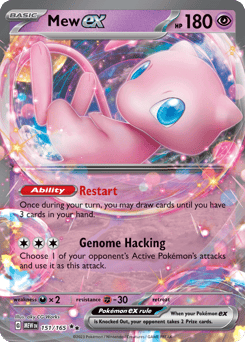
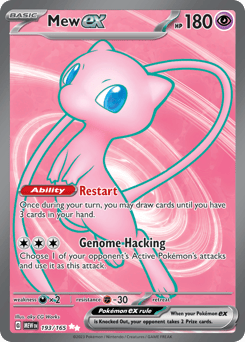
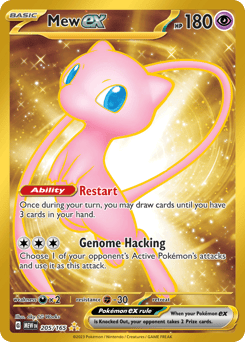
Mew ex from 151 is a clean example of that ladder: the Double Rare sells for about $8.00, the full-art Ultra Rare for about $35.99, and the gold Hyper Rare for about $31.24. Notice the gold card isn't the most expensive. More on that below.
Step 5: Check the stamps and the printing
A few marks change a card's scarcity without changing its rarity symbol.
- 1st Edition stamp. On English cards from Base Set through Neo Destiny, the first print run carries a small black "Edition 1" stamp on the left side under the art. Those copies are scarcer and worth more. The 1st Edition guide shows exactly where to look.
- Shadowless. Base Set only. No drop shadow on the right side of the art box, and a thinner HP font. It sits between 1st Edition and Unlimited. See the Shadowless guide, or the side-by-side in 1st Edition vs Shadowless vs Unlimited.
- Promo stamps. Prerelease, staff, league and event stamps turn an ordinary card into a limited one. Some were handed out in small numbers.
- Error prints. A handful of documented misprints are scarcer than the normal card. Most random ink spots aren't. Our list of error cards worth money covers the ones the grading companies recognize.
If your card is from 1999 to 2002 and has a holo, the edition check matters more than anything else on this page. A 1st Edition Blastoise is a different card to the market than the Unlimited one.
How rarity works inside a modern pack
It helps to know what a pack actually contains, because that's what rarity measures. A standard Scarlet & Violet era booster, as TCGplayer's rarity guide lays out, has four commons, three uncommons, one reverse holo, one slot that's either a second reverse holo or an Illustration Rare, Special Illustration Rare or Hyper Rare, one slot that's a Rare, Double Rare or Ultra Rare, plus a basic Energy and a code card.
So in most packs, your "hit" is a holo Rare. The gold-star cards all compete for a single slot that usually holds a reverse holo, which is why they're so hard to pull.
If you're opening packs, that's also why the cards worth checking are the two reverse holo slots and the rare slot. The other nine cards are almost always what the symbol says they are.
Rare doesn't mean valuable
This is the part people don't want to hear. Rarity tells you how hard a card was to pull. It doesn't tell you how many people want it.
Some very rare cards are cheap. The Hyper Rare Artazon from Obsidian Flames is a three-gold-star card and sells for about $1.30. The Special Illustration Rare Poppy from the same set sells for about $3.19. Both were hard to pull. Nobody was chasing either.
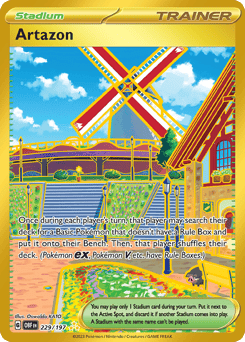
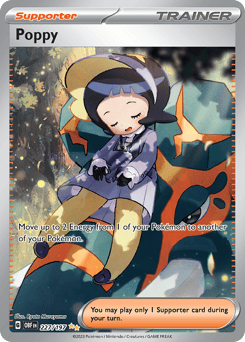
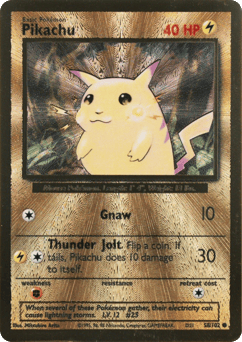
Meanwhile a plain 1999 common like Pikachu (Base Set) sells for about $10.90 ungraded and a lot more in top grades, because it's Pikachu and it's from the first English set. Across our catalogue, the typical Special Illustration Rare sells for several times the typical Hyper Rare, even though the gold cards sit higher on the rarity ladder. Popular Pokémon and good art beat the symbol almost every time.
So use rarity as a filter, not a price. If your card is a secret rare, a special rarity, a 1st Edition holo or a gold-star modern card, it's worth looking up. If it's a common or uncommon from a modern set, it almost never is, reverse holo or not. For the full list of what drives price, see what makes a Pokémon card valuable, and for the cards that are both rare and in demand, rare Pokémon cards worth money.
Then check what it's worth
Once you know your card is rare, the only number that matters is what copies have actually sold for. Search the card on Ultraball by name, then match the set and the card number exactly, because the same Pokémon can have a dozen versions in one set. The card page gives the ungraded price and prices for each grade, from recorded sold listings, and lists separate prices for holo and reverse holo printings where the market treats them differently.
For a whole binder, the price checker guide is the quickest route, and how to tell if your Pokémon cards are worth money gives you a checklist to sort a stack fast. If you think you've found something big, check it isn't a fake first with how to tell if Pokémon cards are fake, then look at the rarest Pokémon cards to see where it sits.